Defend Roseworthy Valley from Industrial Green Waste Development
Defend Roseworthy Valley from Industrial Green Waste Development
Latest: Sept. 4, 2026
Something New – And An Important Next Step!
There has been a great deal happening behind the scenes over the past few weeks. But today there is something BIG to share with everyone!
OUR CAMPAIGN WEBSITE IS NOW LIVE
www.stoproseworthygreenwaste.o…
Read moreThis campaign is about challenging Cornwall Council’s approval of a large-scale industrial green waste site in the Roseworthy Valley.
A major commercial and industrial green waste processing operation has been approved above the Roseworthy Valley, in a sensitive rural location close to homes, farmland and watercourses.
The application site extends to 5.9 hectares (approximately 14.5 acres), within a wider 15.9-hectare landholding (nearly 40 acres in total) under the applicant’s ownership (shown hatched red in the cover photo).
The development raises serious concerns about soil and air contamination, flooding, landscape impact, dangerous HGV traffic volumes and health and safety impacts on local communities.
A High Court legal challenge is now underway and the Court has agreed there is an arguable claim that the decision was made unlawfully. Permission has now been granted and we are seeking support to take this case forward at this critical stage.
This isn’t about compost – It’s about location.
It’s about where we live and work.
ABOUT ME
I became involved with this application after following the planning process closely and becoming increasingly concerned about the location of this development and the risk of lasting and irreversible harm to the surrounding environment, landscape and local communities.
This judicial review has been brought with careful consideration including specialist legal advice with leading counsel, to ensure Cornwall Council’s decision is properly tested in the courts.
INTRODUCTION
This case concerns the approval given by Cornwall Council in December 2025 of a large-scale industrial waste site in a sensitive rural location on high ground in the Roseworthy Valley in Cornwall, close to local communities, productive agricultural land and in close proximity to four designated Sites of Special Scientific Interest.
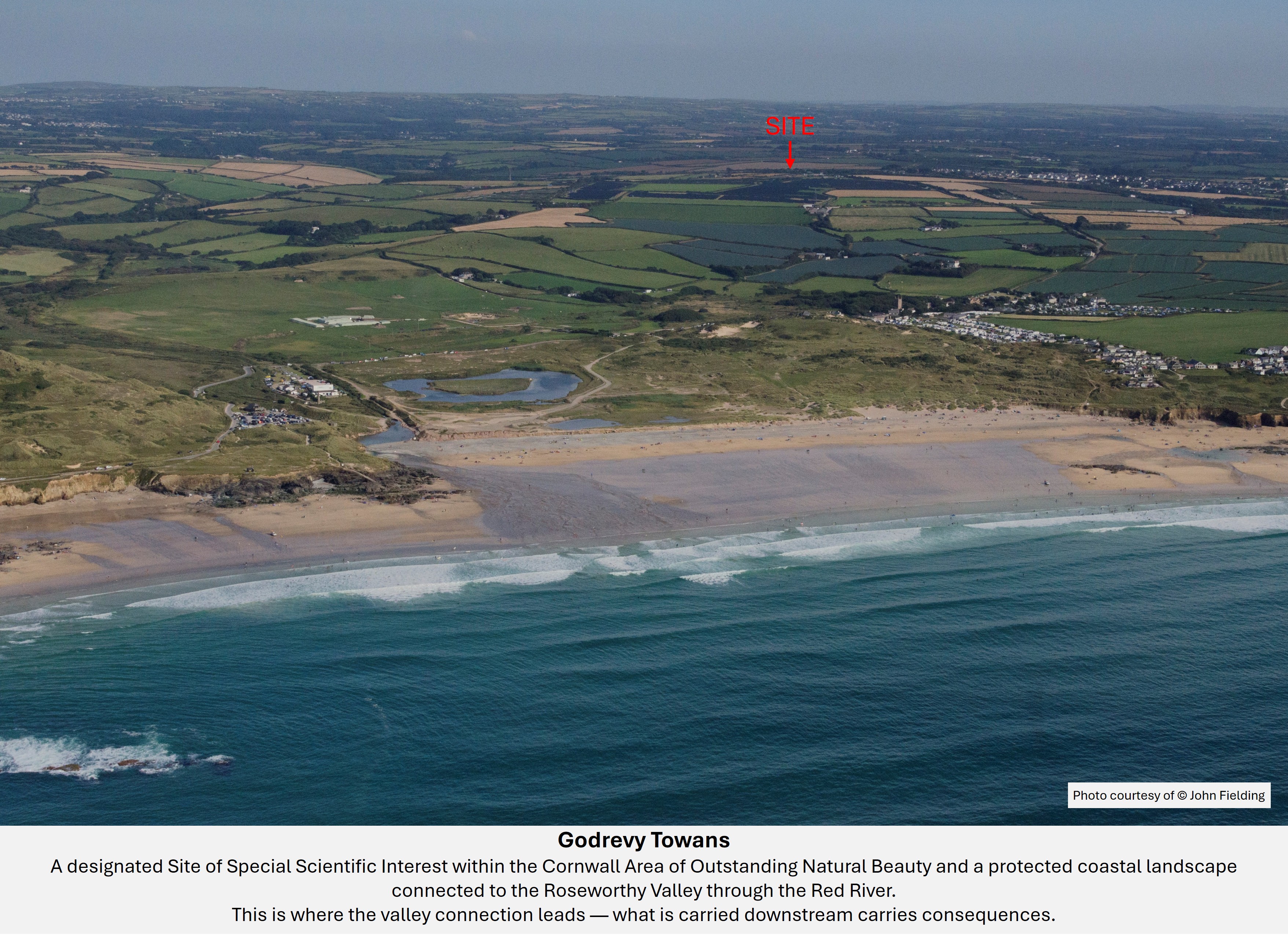
Watercourses on, adjacent to and beneath the site feed directly into the Roseworthy Stream, the Red River and onward to the coast at Godrevy.
This is not simply about a planning decision.
It is about what happens when an industrial-scale development is placed above the environment, the health and safety of local people, farmland and a highly sensitive rural landscape — and the serious and irreversible consequences that may follow.
This facility will impact Roseworthy, Connor Downs and the entirety of Gwithian Gwinear Parish.
Every day, 365 days of the year.
WHAT’S HAPPENING
The approved development is described as a “green waste” facility, but in practice it is a large-scale industrial waste processing operation handling not only green waste, but also wood (including end-of-life timber) and farm plastics, which are often heavily contaminated.
It would operate daily, year-round, and serve a wide area across West Cornwall, as well as Falmouth and Helston.
This is not a small local operation. It is a permanent industrial site in a rural setting, incongruous with the surrounding landscape.
It involves major engineering works to the hillside, including the creation of a vast level concrete platform (approximately 17,400 square metres), likely requiring tens of thousands of tonnes of concrete, fundamentally reshaping the hillside forever.
The applicant’s traffic evidence relies on outdated 2018/19 data from another site. The traffic data does not reflect the company’s own growth since then, nor Cornwall Council’s policy-driven requirement to increase waste capacity.
When those factors are applied, the picture changes significantly:
- Current movements estimate around 15,000 vehicles per year
- Equivalent to over 30,000 HGV journeys on local roads
- Volumes are expected to more than double within a decade if growth continues as the Council's policy demands
This is not a static level of traffic — it is the start of a sustained and accelerating increase, with lorries arriving at and leaving the site morning till night from across West Cornwall, placing growing and unmitigated pressure on narrow, constrained rural roads and the communities they pass through.
The location is central to the concern.
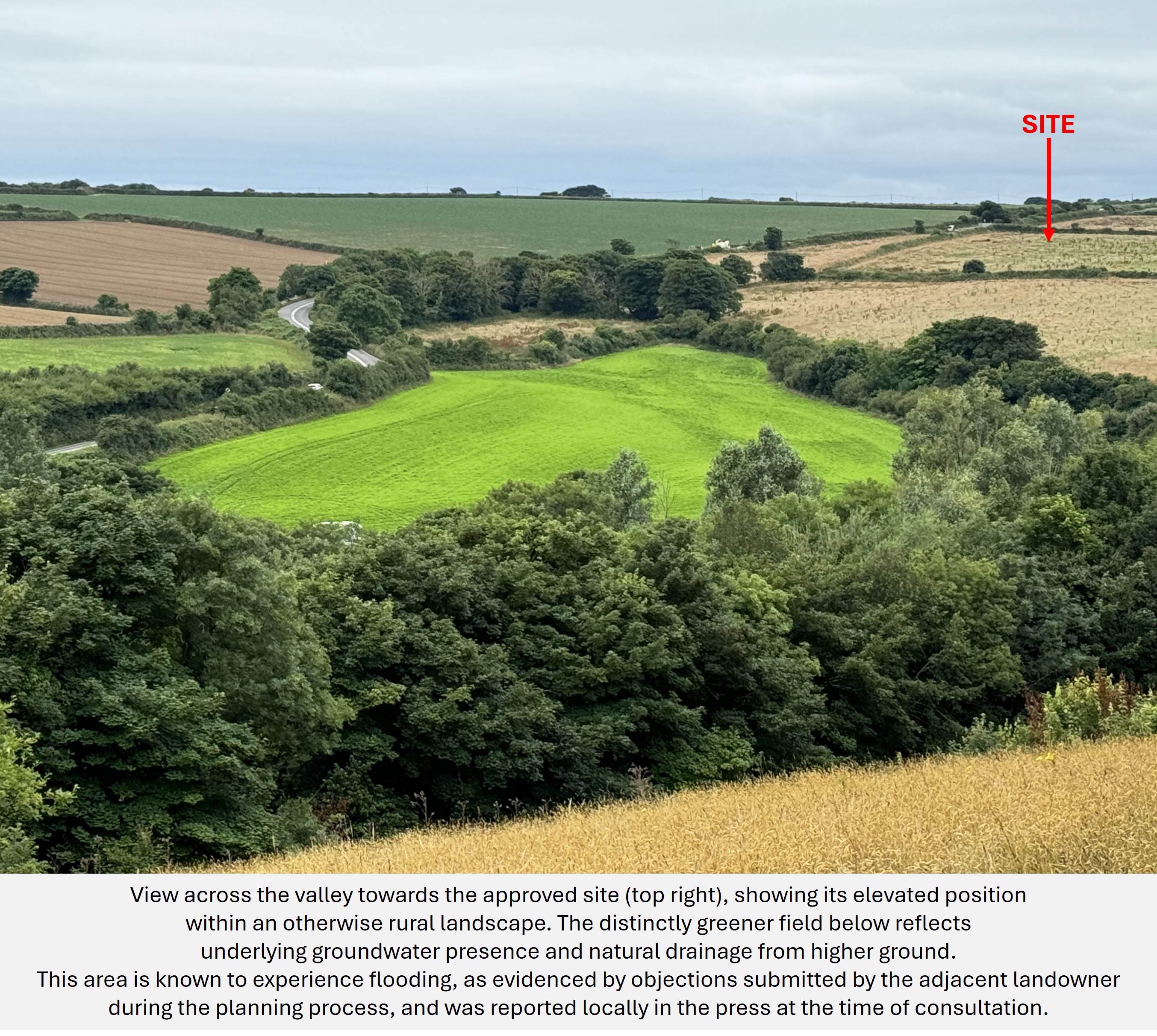
The site sits on a ridge above a valley landscape, with natural drainage pathways leading directly into nearby watercourses and onward to the coast.
The site also lies adjacent to the historic Roseworthy arsenic works, a scheduled monument, and has a known history of elevated heavy metal contamination.
COMMUNITY RESPONSE
The application generated a substantial and detailed local response, with nearly 140 individual objectors recorded on the planning portal and a higher overall number of objections submitted as many individuals engaged at multiple stages, including re-consultation. The Parish Council, local ward councillors and CPRE also objected.
Concerns covered a wide and interrelated range of issues, including environmental impact, hydrology and flooding, public health and wellbeing, site suitability for this type of development, and traffic and road safety.
These were not single-issue objections, with each person raising multiple distinct concerns.
Moreover, even the applicant’s own contamination assessments identified:
- Heavy metals in soils, requiring protective measures including the wearing of PPE during site operation
- Concerns about potential contamination pathways to surrounding land and watercourses
The community raised detailed concerns about how this information was presented throughout the decision-making process. Alongside the environmental and site-related implications, serious questions were also raised about the way both the application was considered and the information was made available to decision-makers. This included whether:
- All relevant material was accurately and properly presented
- Key environmental information was fully assessed
- The process followed was fair, complete and robust
The decision itself was closely contested at the Strategic Planning Committee meeting in December 2025, with the Committee voting 6 in favour, 4 against and 1 abstention.
Despite this level of sustained and significant local objection, planning permission was granted.
WHY THIS DECISION MATTERS
This development would introduce a permanent industrial operation into a rural setting, without co-location alongside existing industrial uses, and outside areas identified for such development in the local plan.
The consequences would extend far beyond the site itself. The applicant owns the adjacent fields and expansion of the site could soon follow, with further industrial applications for development made more likely.
Should this decision stand uncontested, a precedent for industrialisation of the Valley would then be set.
This gives rise to real and well-evidenced concerns about:
- Loss of highly productive agricultural land long used for food growing
- Known flooding and drainage conditions in the area, and how these interact with the proposed development
- Contamination risks associated with waste processing and identified heavy metals in soils, including the potential for leachate and contaminated runoff entering surrounding land and watercourses
- Contamination risks to crops in adjacent fields
- Effect of dust, odour and emissions on nearby communities and everyday quality of life
- Significant increase in heavy goods traffic on narrow rural roads used by residents, including our children and elderly, who would be exposed to increased traffic, dust, odour and bioaerosols in an already busy village environment, close to local schools
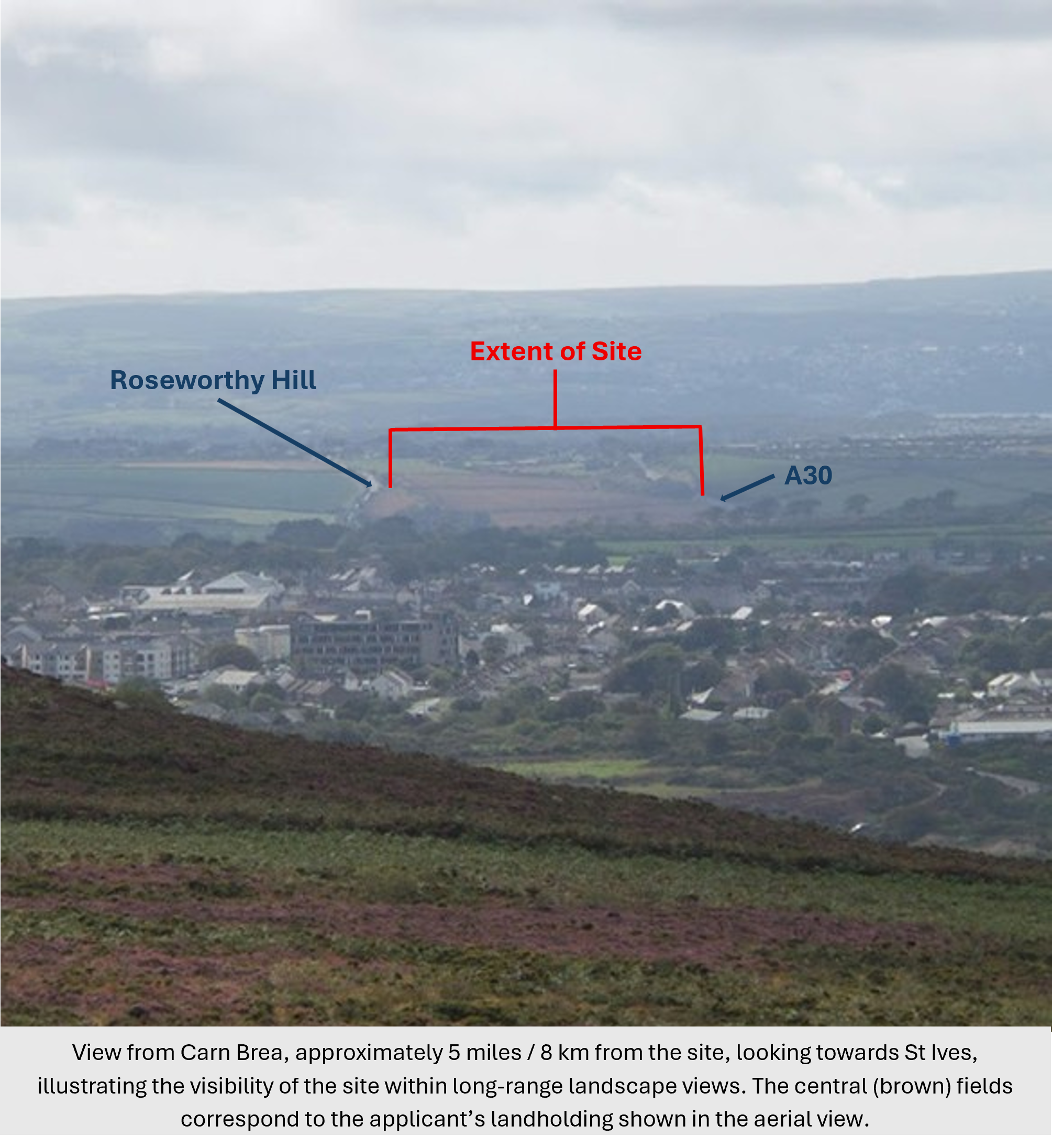
- Visual and landscape impact of an industrial-scale development in an elevated and exposed position, visible from multiple vantage points across the area, including from Carn Brea — a prominent historic hilltop landscape, designated as a Conservation Area and home to scheduled ancient monuments, approximately 5 miles / 8 km from the site — where it would appear as a permanent and scarring feature within otherwise undeveloped long-range views.
These are not abstract risks — they arise from the nature of the development and the characteristics of the site itself.
Once established, the effects of this development are not temporary — they become an irreversible part of the landscape and how people live within it.
Because the site sits directly above a steep valley landscape where water, land and community are closely connected, what happens here does not remain within the site boundary.
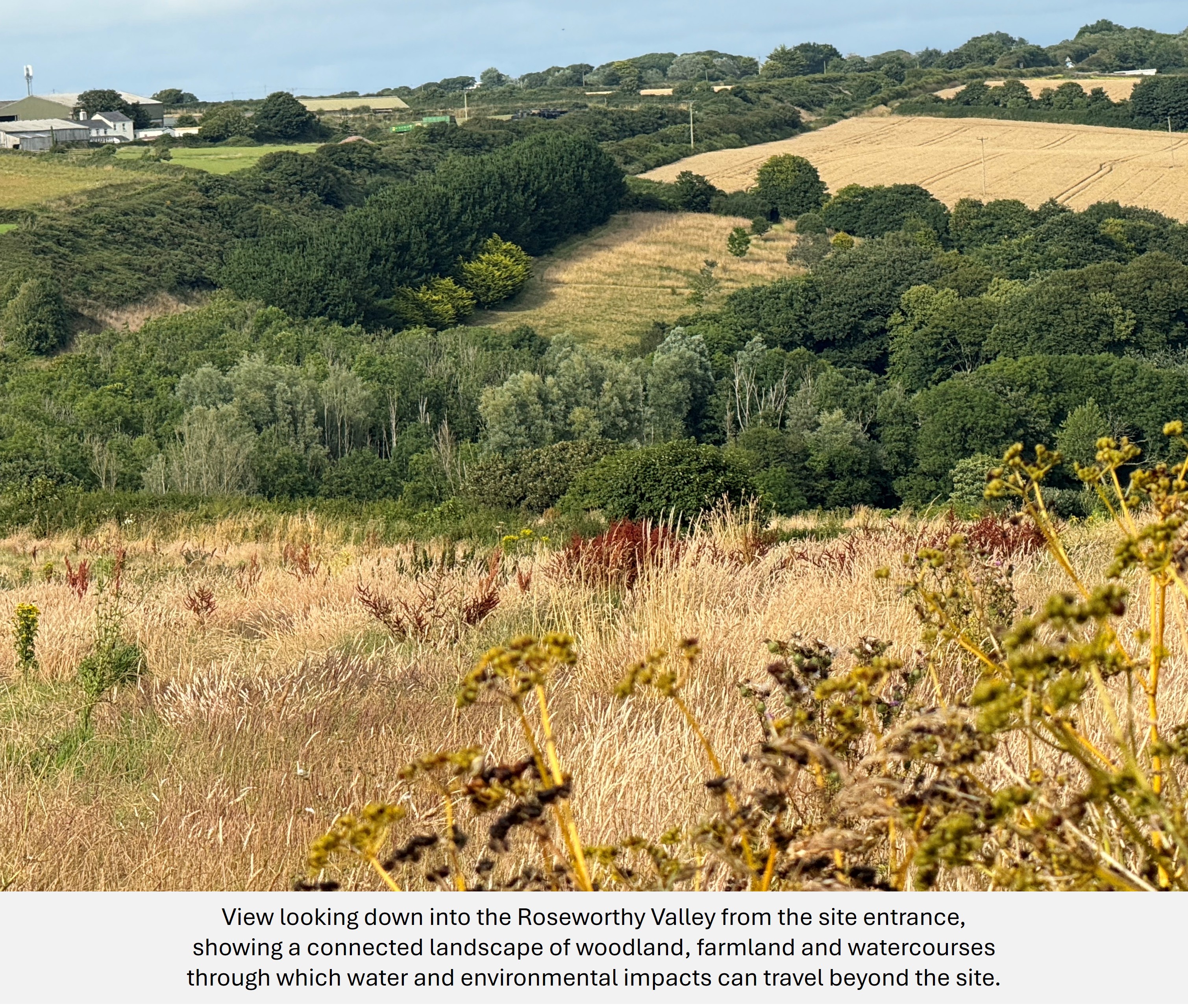
This is not a contained landscape, but a connected and living one through which contaminants are borne by wind and water beyond the site itself and the valley below.
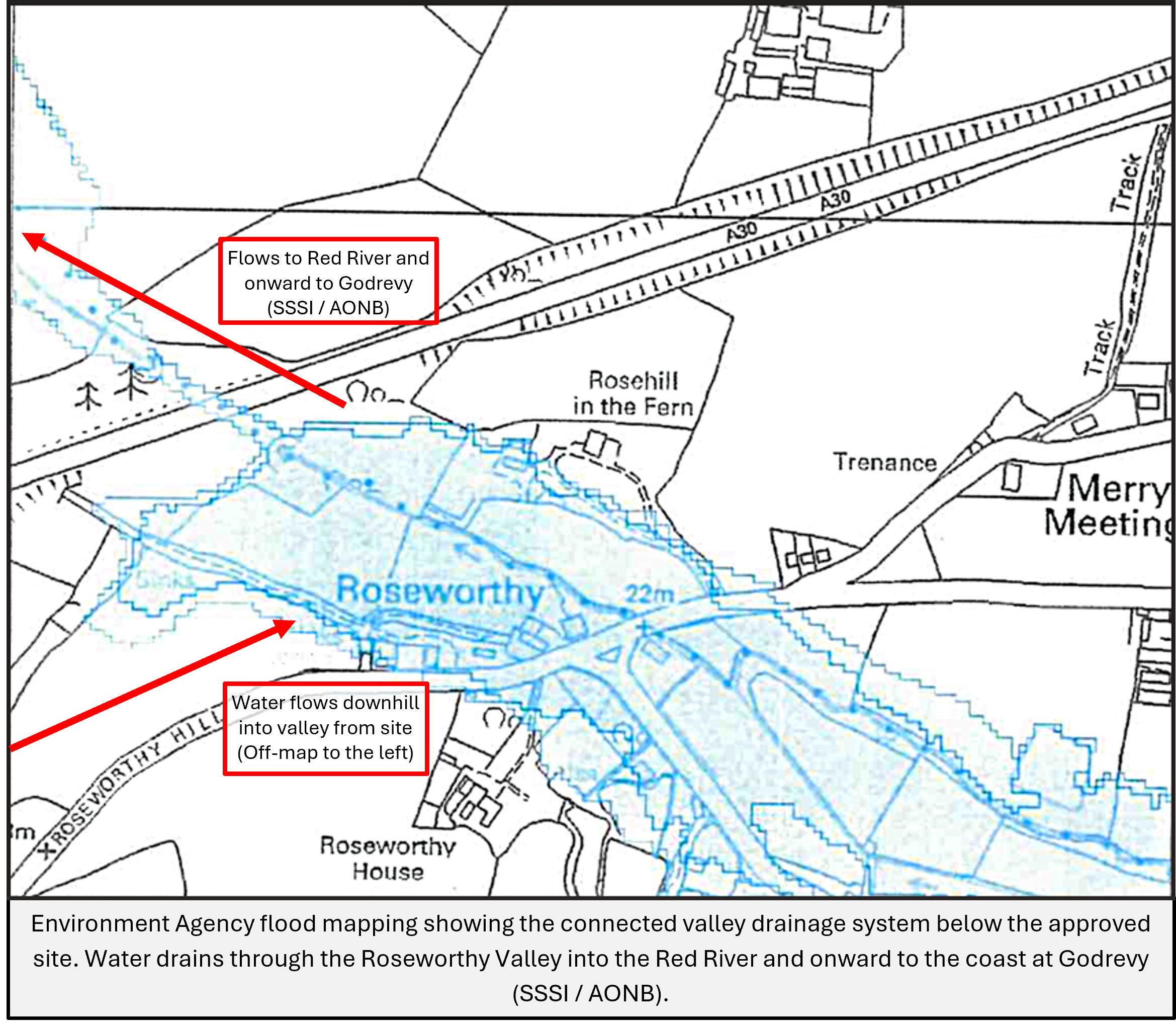
That movement continues through an extended network of watercourses, carrying effects beyond the immediate landscape.
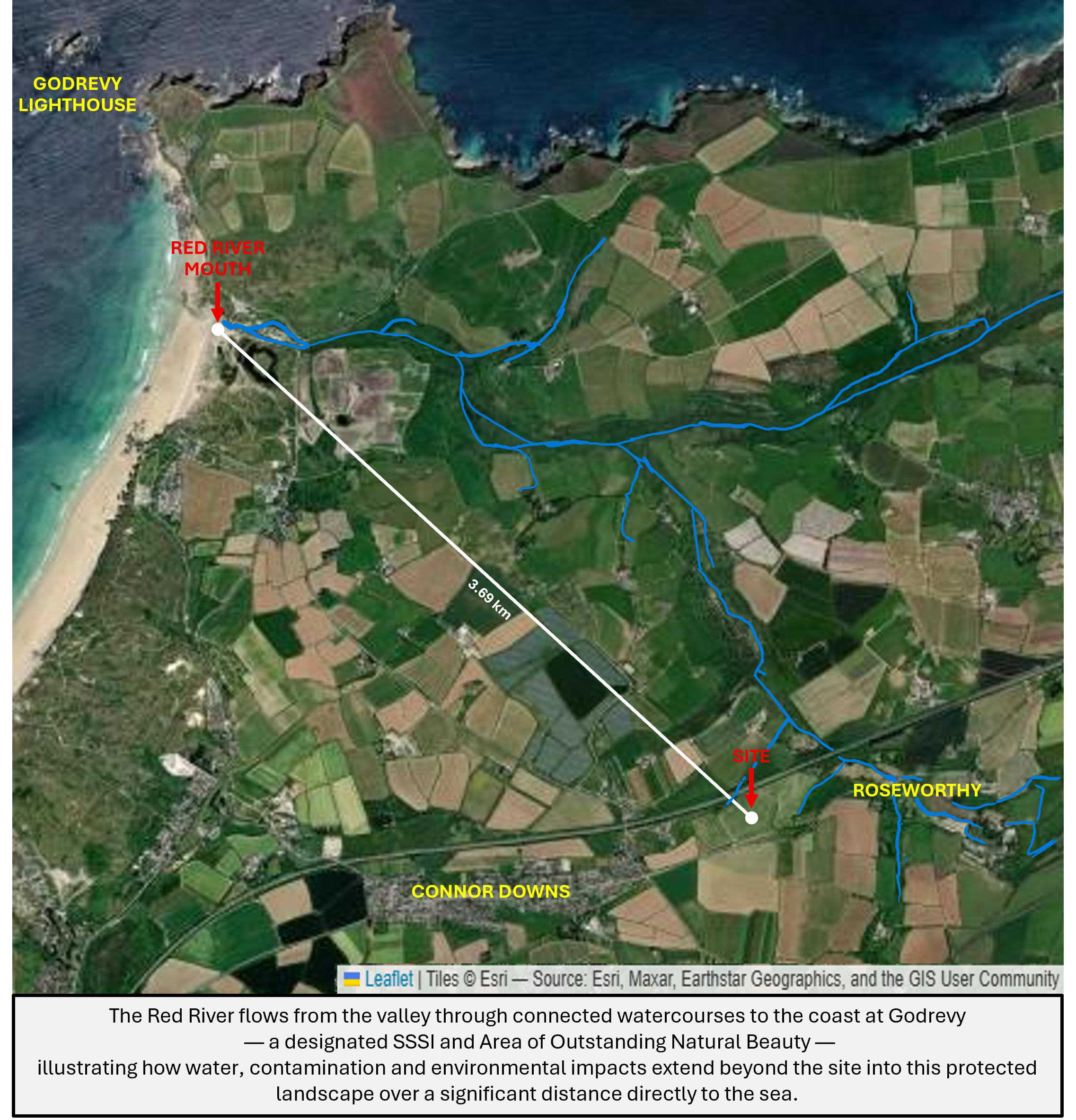
Wind and water contamination carry over great distance, linking the valley to the wider coastal environment.
This is where that connection ultimately leads...
THE LEGAL CHALLENGE
This case is not about re-running the planning merits.
It is about whether the decision to grant permission was made lawfully.
I have been given permission by the High Court to challenge Cornwall Council's decision at judicial review. Four of the six legal grounds advanced have been granted, confirming that key aspects of the case are properly arguable.
The case has already passed an important legal threshold, and will proceed to a full hearing. This reflects the importance of ensuring that all relevant matters are properly considered and assessed.
These include whether:
- The Council’s decision-making process was procedurally fair
- The Council’s relevant planning policy was correctly applied
- Important environmental information was properly considered and consulted on
Taken together, these issues are being challenged on the basis that the decision was not made in a legally adequate and properly informed manner.
I am currently seeking permission to pursue the outstanding two legal grounds which relate to the treatment of objections, environmental assessment and the adequacy of the information before decision-makers.
The case is now listed for a hearing in the High Court this December, with an interim hearing to take place quite shortly.
WHAT THIS CASE SEEKS TO ACHIEVE
This judicial review seeks to ensure that the decision to grant planning permission is properly tested in the High Court.
If successful, the Court can quash the permission, requiring the application to be reconsidered through a lawful and properly informed process.
This would ensure that the environmental, planning and community issues raised are fully and fairly assessed before any new permission for this development can be granted by the Council.
WHY YOUR HELP IS NEEDED
Legal challenges of this kind are complex and costly, particularly where specialist planning and environmental law issues are involved.
I began this legal challenge in December 2025 with the support of specialist solicitors and King's Counsel experienced in environmental judicial review. I have funded the case to this point personally and cannot continue alone.
While the claim benefits from Aarhus costs protection, which limits my potential liability for the other side’s costs if the case is unsuccessful, it does not cover the costs of bringing the case itself - and the next stages involve significantly higher costs. Based on current estiamtes, the overall cost of taking this case through to a full substantive hearing is likely to be a further £50,000.
Our initial fundraising target is set to £4,000 as this will cover the cost of the upcoming renewal hearing. As the case advances, we will provide regular updates so you can follow our progress closely.
Your contributions will fund:
- Specialist solicitors and King’s Counsel
- Court fees
- Legal preparation, advice and strategy
HOW YOUR SUPPORT WILL HELP
This campaign will be funded in stages, aligned with key points in the legal process.
This means you can see clearly what each stage is funding and how the case is progressing.
Every contribution, however big or small, helps ensure the case is heard fairly and properly. All contributions are handled through CrowdJustice to settle legal fees - no funds are received personally.
WHY THIS CASE MATTERS MORE WIDELY
This case is about more than one site. It raises much wider questions about:
- How planning decisions are made
- How environmental risks are assessed; and
- How communities are represented in that process
PLEASE HELP
If you are able to offer financial support, your contribution ensures this case can be properly heard at a critical stage.
If you are not able to donate, sharing this campaign as widely as possible — and encouraging others, including individuals and organisations who may be able to support — is equally valuable and helps more than you might realise.
Thank you so much for your support.
Kim Hillier
Sept. 4, 2026
Something New – And An Important Next Step!
There has been a great deal happening behind the scenes over the past few weeks. But today there is something BIG to share with everyone!
OUR CAMPAIGN WEBSITE IS NOW LIVE
www.stoproseworthygreenwaste.org
I must give a big thank you here to ACM Design Company, who have transformed an enormous amount of material into something accessible and powerful.
For the first time, the story of this development has been brought together in one place: what is proposed, where it would go, its sheer scale, the important concerns that have been raised, the unanswered questions and, of course, the High Court challenge.
But more than anything, I wanted the website to explain what has driven this campaign from the beginning: why what happens in a field on this hillside matters far beyond the boundary of the site itself – and to the very future of this place.
What happens here will not affect just one agricultural field or be simply the misfortune of those living closest to it.
THIS DEVELOPMENT AFFECTS EACH AND EVERY ONE OF US.
The risks do not stop at the site boundary – and neither will the irremediable consequences – airborne dust and polluted air, oppressive odours, intrusive noise seven days a week, dangerous and congested roads, contaminated water and permanent damage to wildlife and habitats.
NONE OF US IS A BYSTANDER.
This is about the life you live, the roads you travel, the air around your home, the land that grows our food, the water flowing through our communities and the wildlife, countryside and coastline we all value.
We have a personal stake in all of this.
These are shared and special places, resources and freedoms that shape our everyday lives and that we hold in trust for those who come after us.
SOME CHANGE IS INEVITABLE. IRREVERSIBLE HARM IS NOT.
The waste has to go somewhere.
But that does not mean it should go anywhere.
This campaign has never been about stopping composting or green waste recycling. It is about whether an industrial operation of this nature and scale belongs in this particular place.
It doesn't. This is totally the wrong place.
THIS ISN'T ABOUT COMPOST. IT'S ABOUT LOCATION.
Please have a look. Explore it. Share it. Whether you already know this campaign well or have only just found us, it will bring home just how much is at stake – and why what happens next matters to all of us.
Planning permission does not make this development inevitable.
WHAT HAPPENS NEXT IS NOT YET DECIDED.
But if we do not come together now to fight this, the Council's decision will remain unchallenged. There will be no turning back, no second chance.
This is the last chance to challenge the lawfulness of the Council's decision, fight to have the planning permission quashed and stop this development.
It is a real opportunity to win.
THE NEXT FUNDRAISING TARGET
Together, we have already succeeded in bringing this challenge all the way to a two-day High Court hearing in December. Now we have to raise the funding to get into that courtroom.
We began this CrowdJustice campaign just over 90 days ago with an initial £4,000 target. From the very start, public support has proved incredible and that first target was reached in less than two days! The target was stretched to £7,500, then £12,000 – and today we are less than £700 away from that target.
So I am now increasing our stretch target to £20,000.
This is because from here, the legal work becomes increasingly intensive – and increasingly expensive. Our specialist environmental solicitors and King's Counsel must undertake the detailed work required to prepare and present the case, respond to the Council's position, deal with the evidence and legal arguments across the grounds before the Court, and ultimately represent the challenge at the hearing itself.
We expect to need around £50,000 from this point to take the challenge through the substantive High Court hearing in December. That figure relates to the complex legal work still ahead, including the upcoming preparation of the detailed skeleton arguments.
The £20,000 stretch goal is therefore not the finishing line. It is our next target – an achievable stage towards raising what we need to get into that courtroom in December.
ONLY YOU CAN MAKE A DIFFERENCE TO THE FINAL OUTCOME.
Public concern, practical and moral support, together with financial contributions, have already been turned into meaningful legal action, bringing this challenge all the way to a two-day High Court hearing, with four grounds already having permission to proceed and the renewed application on the remaining two to be considered immediately beforehand.
If you can donate, however great or small, please do. And whether or not you can donate, please share the new website and this CrowdJustice page.
Every person who encounters this campaign because somebody else shared it takes us one step further. There are friends, communities, charities, businesses and groups of like-minded people that I could never hope to reach alone.
ONE PERSON CAN START A CAMPAIGN, BUT IT TAKES A COMMITTED COMMUNITY TO GET THE FIGHT OVER THE LINE.
And that brings me to some words recently passed on to me by another campaigner, following the successful conclusion of another long-running Cornish campaign to protect a place its community cared deeply about.
I am borrowing them now because I can think of nothing more appropriate:
“Never doubt that a small group of thoughtful, committed citizens can change the world. Indeed, it is the only thing that ever has.”
Widely attributed to Margaret Mead
When this CrowdJustice campaign began just over 90 days ago, I could not have known how many people would choose to stand behind it. Today, 81 donations have been made, while many more people have shared the campaign, displayed posters, delivered leaflets, talked about what is happening here and helped it reach others.
Our support is growing. The campaign is growing. And together, we have already taken this much further than one person ever could.
BUT THE OUTCOME IS STILL YOURS TO INFLUENCE – AND THE OPPORTUNITY TO DO THAT WILL NOT COME AGAIN.
There is still a long way to go, but all our individual contributions are combining into collective strength.
Please join us. Please donate. Please share. And please help us get into that courtroom in December.
This is still David and Goliath.
But David no longer stands alone.
Kim Hillier
July 15, 2026
Another Major Step Forward for the Stop Roseworthy Green Waste Campaign
I am delighted to be able to share a tremendous update with you!
Many of you may know that at the end of March, the Court granted permission for four of my six legal grounds to proceed to the substantive Judicial Review hearing.
That itself was a brilliant achievement, but it was not the end of the story. On the expert advice of my excellent legal team, we asked the Court to reconsider the two refused grounds at a rolled-up hearing alongside the substantive claim.
I have just received news that the High Court has made a very important Order in our case, and I am absolutely delighted to let you know that the Court has directed that these remaining grounds will be reconsidered.
This means that all six legal grounds I asked the Court to consider will now come before the High Court at the substantive hearing in early December, providing a stronger platform from which to challenge Cornwall Council's decision to approve an industrial green waste site at Roseworthy.
The December hearing has also been extended from one and a half days to two days to accommodate the additional issues the Court will now consider.
This is a very significant development. The Court will first decide whether these remaining parts of my legal challenge should proceed and, if so, determine them as part of the substantive hearing in December.
This is exactly why every donation and every act of support matters so much.
Every pound you have contributed has helped place this case in the hands of outstanding King's Counsel and specialist environmental solicitors, whose commitment, expertise and determination have enabled us to reach this point. Together, we have brought the case to the point where every one of the six legal grounds I asked the Court to consider now remains alive for determination.
There is, of course, still much work to be done as we prepare for the hearing in December. Today's Order is not the end of the journey, but it marks a further significant milestone and reinforces the importance of these issues being fully examined by the High Court.
If you are reading this for the first time, it would be fantastic if you could support the campaign by donating, sharing this page and simply helping to spread the word. Every contribution helps ensure these important issues receive the careful scrutiny they deserve before the High Court.
Thank you to everyone who has already donated, shared the campaign or encouraged others to support it. Your generosity has brought the case to this important stage.
This has always been David and Goliath. Today, David has taken another important step forward.
Kim Hillier
June 30, 2026
Together, we're making this happen – thank you!
Thank you once again for the extraordinary support this campaign continues to receive, and for your shared determination to take this to the High Court.
With the first stretch target of £7,500 nearly met, I have now increased the campaign target to £12,000 to help fund the next stage of this High Court challenge.
The case continues to gather momentum. The High Court has already granted permission for four legal grounds to proceed to the substantive hearing this December. Meanwhile, our legal team continues to press for the remaining two grounds to be reconsidered at an oral hearing, and we are currently awaiting the Court's response.
Every pound raised so far has been transformed into real legal progress. Your contributions have enabled leading King's Counsel and specialist environmental solicitors to advance the case robustly on behalf of everyone who believes this development should never have been approved in such a sensitive location. Thank you for standing with me and helping to give this challenge the strongest possible chance of success.
This challenge has never been about one field or one planning application. It is about protecting an irreplaceable part of Cornwall from inappropriate industrial development and ensuring that important environmental and legal issues receive the independent scrutiny they deserve.
As we move closer to the December hearing, substantial work remains to be done. The increased target will help ensure that our experienced legal team can continue bringing the same enthusiasm, commitment and expertise to preparing the strongest possible case every step of the way.
To everyone who has donated, shared the campaign or encouraged others to support it, thank you. Your support, confidence and determination are turning public concern into meaningful legal action. Your backing is no longer simply funding a legal challenge; it is enabling one of the country's leading planning King's Counsel and specialist environmental solicitors to continue holding this decision to account before the High Court.
This has always been David and Goliath. History reminds us that David won. Together, we can make the difference.
Please continue sharing the campaign with friends, family and colleagues. Every introduction has the potential to reach someone who cares about Cornwall and wants to help protect it. Every donation, however large or small, brings us one step closer to presenting the strongest possible case before the High Court.
Thank you to everyone.
Kim Hillier
June 9, 2026
An incredible start – thank you!
In less than two days we reached our initial fundraising target of £4,000 and have now set a stretch target of £7,500.
I want to say a huge and heartfelt thank you to everyone who has already donated, shared the campaign and sent messages of encouragement. Your generosity and support have been truly amazing. Every contribution is helping to ensure that these important questions can be properly heard.
This campaign is about far more than one field or one planning application.
It is about safeguarding an irreplaceable place that embodies the very best of Cornwall – where open countryside, highly productive farmland, wildlife, heritage and communities come together at the gateway to West Cornwall, nestled between four Sites of Special Scientific Interest and the internationally important coastal waters of St Ives Bay and the iconic Godrevy coastline.
If allowed to proceed, this development would industrialise the very gateway to West Cornwall, replacing open countryside with a large-scale green and wood waste processing operation and setting a precedent for further industrial encroachment into this sensitive landscape.
As our campaign says, this isn't about compost – it's about location. The questions before the High Court matter not just for one field, but for the wider landscape, its wildlife, its heritage and the communities that depend upon it.
Every contribution matters. This is David and Goliath stuff. We are not simply funding a legal challenge – we are standing together as custodians of an irreplaceable part of Cornwall. One person can start a campaign, but it takes a community to get this fight over the line. Together we can be mighty and make our voices heard in the High Court.
Thank you for joining our campaign and helping to protect Cornwall's heritage, its precious landscapes, our communities and the wildlife that has no voice.
Please keep sharing our campaign – together we really can make a difference.
Recent contributions