TASC’s new legal challenge against Sizewell C’s secret flood defences
TASC’s new legal challenge against Sizewell C’s secret flood defences
Latest: Feb. 18, 2026
Sad news and big thank you to all TASC's supporters
Together Against Sizewell C Ltd (TASC) is extremely disappointed to advise you that our appeal against the Secretary of State, Ed Miliband’s, decision to not give public scrutiny and assessment of Si…
Read moreTogether Against Sizewell C (TASC) is a community-based group of like-minded individuals who have been actively campaigning on a voluntary basis, since 2013, to stop the Sizewell C project.
TASC urgently need your help in our battle against the environmentally damaging Sizewell C project. We have discovered that the project now includes a stated commitment by Sizewell C Ltd to the Office for Nuclear Regulation (ONR) to install additional sea defences in a 'credible maximum' climate change scenario. These defences in the form of two huge 10 metre high ‘overland flood barriers’ were not included in the approved DCO project. In our opinion, these flood barriers, if installed, will likely have additional adverse impacts on the neighbouring designated wildlife sites including RSPB Minsmere as well as the Heritage Coast and Suffolk Coast & Heaths National Landscape. We need to ensure that the original promotor EDF and the now UK government controlled Sizewell C Ltd are not allowed to use climate change uncertainties as an excuse to delay assessment and avoid public scrutiny of these additional structures for decades. The full impact of the whole project should be assessed now.

Above picture taken from ONR’s External Hazards Proportionate Reassessment report May 2024 which first drew TASC’s attention to the overland flood barriers.
There is very little detail about the barriers, but it appears from the above diagram that, if needed:-
The Southern barrier stretches for nearly 500 metres from the Sizewell A site, across the Sizewell Gap to the start of the cliffs running south to Thorpeness, sited on land not in Sizewell C’s ownership.
The Northern barrier potentially stretches from the north of the Sizewell C site, through the SSSI, then inland over Goose Hill for up to a kilometre.
Together with our lawyers, Leigh Day, we have sought the High Court’s permission to apply for judicial review of the decision of the Secretary of State to refuse TASC’s request to revoke or vary the Sizewell C DCO. The grounds for our legal challenge are set out in Leigh Day’s press release.
To cover our legal costs to get to a High Court hearing, TASC urgently needs to raise £20,000. We are extremely grateful to all those who are able to contribute and/or share details of our fundraiser with others.
How we got here
From documents obtained under a Freedom of Information (FOI) request, TASC found out that EDF knew as far back as 2017 that their chosen nuclear platform height of 7.3m AOD would, along with the adapted sea wall on the eastern flank of the site, require two 10-metre high ‘overland flood barriers’. These will be needed to prevent the nuclear platform from flooding from the west in the event that sea level rise reaches a ‘credible maximum’ scenario. This will lead to a major breach of the low-lying coast to the north of Sizewell C and south of the Sizewell nuclear cluster. However, while EDF rightly included the adaptive design of the eastern sea defences in their DCO application documents, they did not include the southern and northern overland flood barriers in the DCO application, thereby avoiding any public scrutiny. As a result there is no commitment in the approved DCO to install these additional sea defences. This is despite there being a requirement to keep the nuclear site safe for its full lifetime from climate change impacts in a credible maximum scenario i.e. to, at least, 2160 while spent nuclear fuel is stored on site.
TASC’s aim is to ensure that the overland flood barriers, not included by EDF in the DCO application, now form part of the overall project. Therefore we need the Secretary of State to either revoke or change the DCO, in order that a lawful assessment of the potential environmental impacts of the entire project is carried out and subject to public scrutiny.
This is important because the project may be grossly underestimating the potential environmental impact, flood risk and sea-defence costs. This, if unaddressed, could be a major burden on future and far future generations who may be impacted by severe, non-reversible environmental, ecological and human impacts combined with an extreme financial liability if Sizewell C were to flood.
Further background for those that want to know more
The Sizewell C project, originally promoted by EDF, is to build twin EPR nuclear reactors close to the North Sea at Sizewell, Suffolk, one of the fastest eroding coastlines in Europe. The site is in the heart of Suffolk Coast & Heaths National Landscape, largely surrounded by designated wildlife sites including RSPB Minsmere and will be partially built on Sizewell Marshes SSSI.
In 2021, Prof Paul Dorfman’s report stated “…any adaptation efforts to mitigate annual flooding (projected to almost entirely surround the proposed EDF Sizewell C EPR nuclear island by 2050) will inevitably entail significantly increased expense for construction, operation, spent nuclear fuel management, rad-waste storage and eventual decommissioning”.
In line with the ONR’s preference, Hinkley Point C is a ‘dry site’ i.e. its platform height at 14 metres AOD is of sufficient height to prevent it from flooding. However, Sizewell C with a platform height of 7.3m AOD, is a ‘protected site’ which means that Sizewell C must at all times demonstrate that the site can be protected against flooding for its full lifetime by use of ‘permanent external barriers such as levees, sea walls and bulkheads’. Once Sizewell C is constructed with a 7.3m AOD platform height, the platform cannot be raised at a later date. The overland flood barriers need to be assessed now so alternatives can be considered e.g. raising the platform height.
Sizewell C was given DCO approval in July 2022 against the recommendation of the five professional planning inspectors. In TASC’s view, the impacts from the overland flood barriers, if they had been assessed during the DCO examination, may well have resulted in planning permission being refused. In any event, our case argues that the Secretary of State’s ‘Habitats Regulation Assessment’ has not considered the environmental impacts of the full project or alternatives, something that is a lawful requirement.
Documentation published by the ONR supporting their grant of Sizewell C’s nuclear site licence in May 2024, has revealed that, in TASC's opinion, there are now two materially different projects, the one in the DCO approved by Kwasi Kwarteng, and the one still being considered by the ONR as part of the ‘site safety case’. It was an FOI request to the ONR in late 2024 that provided the documentation from 2017 that shows the project requires the adaptive flood protection in the form of the overland flood barriers in a credible maximum climate change scenario.
The Sizewell C site will be storing up to 4,000 tonnes of spent nuclear fuel on this vulnerable coastline until the late 2100s. The precautionary principle should surely apply so resilience, potential risks and impacts are assessed on a worst case basis and that should be done now. Sizewell C Ltd seem to believe they can do as they see fit with our Heritage Coast, National Landscape and designated wildlife sites irrespective of the damage they will cause.
In an attempt to resolve our concerns, on 6th March 2025 TASC wrote to Secretary of State, Ed Miliband calling on him to make a decision on whether the material change to the Sizewell C project highlighted by TASC, namely the commitment to install ‘overland flood barriers’, ‘amounts to exceptional circumstances that make it appropriate for him to exercise his power to change or revoke the DCO’.
The Energy Minister, on behalf of the Secretary of State, replied on 28th March 2025, refusing TASC’s request to vary or revoke the DCO. As TASC consider this matter to be of great importance, we have been left with no alternative but to challenge the Secretary of State’s decision through the courts.

Aerial view May 2025, of Sizewell C’s main development site where 22,000 trees have been felled
Those that live in the Sizewell area or know it well are only too aware that Sizewell C has already caused extensive environmental damage prior to a final investment decision by the government – sadly, Suffolk now has its own version of HS2! The UK government currently own 88% of Sizewell C with EDF owning the remaining share. To date, £6.4 billion of UK public funds have been committed to the project. In our view, the lack of an assessment of the full project needs to be resolved before the government makes a FID which would involve committing further billions of public funds to Sizewell C.
To those, such as Keir Starmer, who like to use inflammatory language to call us ‘NIMBYs and blockers’, we say that we would not be in this situation if the developer had been open and transparent by including the overland flood barriers in the DCO application. In addition, this action may have been avoided if our concerns about this matter had been fully addressed when previously raised with the Dept. for Energy Security and Net Zero.
Thank you so much to all those supporting our campaign.
(Note: hyperlinks to supporting documentation are provided in the list of Annexes in the above referenced letter of 6th March 2025 to Ed Miliband)
Get updates about this case
Subscribe to receive email updates from the case owner on the latest news about the case.
Together Against Sizewell C (TASC)
Feb. 18, 2026
Sad news and big thank you to all TASC's supporters
Together Against Sizewell C Ltd (TASC) is extremely disappointed to advise you that our appeal against the Secretary of State, Ed Miliband’s, decision to not give public scrutiny and assessment of Sizewell C’s secret sea defences, has been refused (only a few days after our final submission). We are, however, thankful that our legal challenge has helped to expose the Sizewell C project’s lack of resilience to extreme climate change because there is no provision for the two additional sea defences in the approved DCO.
None of this would have been possible without your support - not just financially but also from the words of encouragement to continue this campaign. For this, TASC is hugely grateful.
TASC fear for the safety of our descendants and the precious Suffolk coastline because this judgement leaves future generations to rely on the developer’s ‘hypothetical’ i.e. imaginary, unassessed additional sea defences to protect Sizewell C and its 3,900 tonnes of spent nuclear fuel from flooding in an extreme sea level rise scenario over the next 150 years.
The Appeal Court’s decision sanctions the Government and developer’s choice to push ahead with £40 billion Sizewell C which is sited on one of Europe’s fastest eroding coastlines. Recent rapid erosion at nearby Thorpeness has resulted in many homes having to be demolished and in front of the development site the beach may need to be replenished before the nuclear plant has even been built - demonstrating the threat of erosion is real and immediate and should be a wake-up call for government that Sizewell is not a suitable site for new nuclear.
This government wants to ‘rip up the rules to fire-up nuclear power’. TASC, however, believe there should be an inquiry into how the developer, EDF, was allowed to exclude the additional sea defences from their 2020 DCO application, even though national policy statements require developers to include plans for adaptive sea defences to deal with a credible maximum climate change scenario - EDF knew as far back as 2015 that the site requires additional flood defences in an extreme sea level rise scenario but chose to keep them secret, thereby avoiding public scrutiny and environmental impact assessment. One would hope that any sensible government would want to guarantee there is a viable, fully assessed plan to ensure the plant and its spent fuel can be kept safe for its full lifetime to avoid a catastrophic event - apparently not!
Despite this legal setback, TASC intend to continue to hold the government, its agencies and Sizewell C to account, particularly in the matter of flood and coastal erosion risks.
And once again, many thanks - we could not have done this without you and our excellent legal team.
Note 1 Para 5.07 of the minutes of the Sizewell C Marine Technical Forum: Quarterly Meeting, 2nd September 2025 states, “"TD [Cefas, on behalf of SZC Ltd] explained that the northern end of the beach has shown a relative increase in erosion over the last few years, detected by the CPMMP drone flights, and that while not explicitly stated within the CPMMP SZC might wish to supplement the dune volume with additional sediment. TD explained that, on the basis of work detailed in the CPMMP, the area from approximately just south of the TMBIF to the northern SZC site boundary would benefit from additional material.”
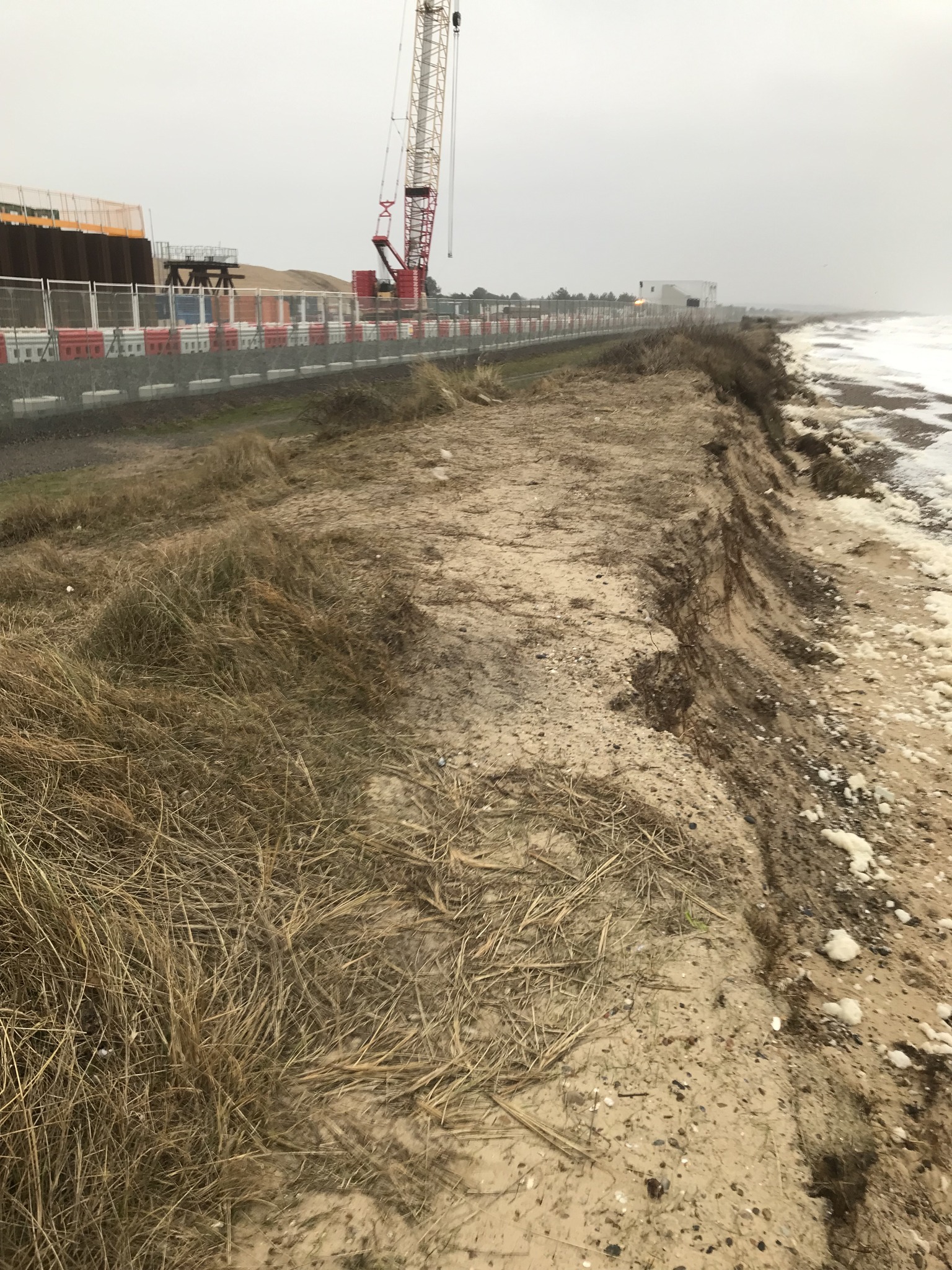
Photo: The vulnerable coastline in front of the Sizewell C site, February 2026
Together Against Sizewell C (TASC)
Feb. 8, 2026
TASC lodge appeal against High Court judgement
TASC is pleased to say that following discussions with our legal team, we have submitted an appeal against the High Court’s refusal of our judicial review request. TASC is determined to use every avenue open to us to ensure public scrutiny and environmental assessment of the two huge additional sea defences that Sizewell C have committed to install in an extreme sea level rise scenario, these having been excluded from the 2020 planning examination by EDF even though they knew as far back as 2015 the additional sea defences would be required.
Recent rapid erosion along the Suffolk coast has demonstrated that the power of the sea cannot be ignored. At Thorpeness, this erosion has been devastating, especially for residents whose homes are at risk and those whose have already been demolished. Just a short distance from Thorpeness is the vast Sizewell C construction site which, before the plant has even been built, is being exposed to an increased rate of coastal erosion meaning that the beach and dunes may need replenishing now (note 1). This is despite the developer claiming in revision 4.0 of their Site Data Summary Report, September 2021 that “The following hazards are not considered as coastal flooding hazard initiators: Coastal erosion – this phenomenon is a slow process…”! This illustrates why it is imperative that the additional sea defences are assessed now.
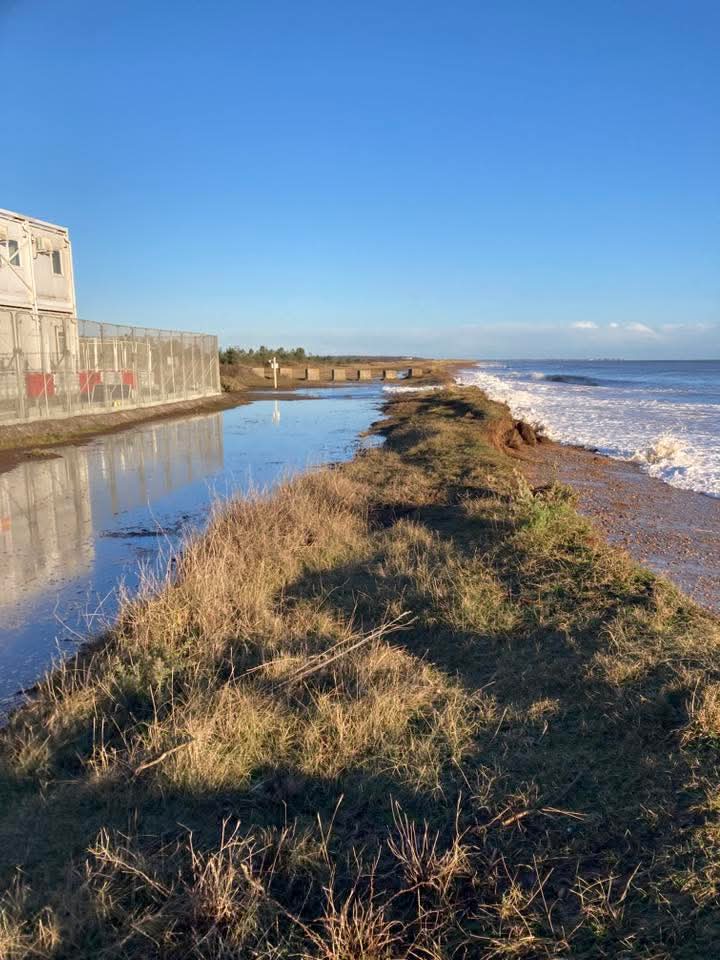
Photo showing waves overtopping the dunes in front of the Sizewell C site, 02/01/26
Sizewell C is sited on one of Europe’s fastest eroding coastlines and government policy EN1 and EN6 states that nuclear power station developers should be able to demonstrate that the flood protection measures are adaptable to a credible maximum climate change scenario (note 2). The Habitat Regulations dictate a precautionary principle should apply, so TASC had genuine hope when we advised the Secretary of state, Ed Miliband, of our concerns, he would deal with the points raised in an open and transparent manner - particularly as, at that time, a final investment decision had not been made and the government were still considering whether to commit billions of public funds to the project. Instead, the Minister at that time, Lord Hunt, on behalf of Ed Miliband, chose to ignore the dangers of moving ahead with Sizewell C without demonstrating that there is a viable option to keep the site safe from flooding in an extreme sea level rise scenario over the site’s full lifetime and opted to kick the can down the road, expecting future generations to clear up the mess from ill thought out decisions made today.
Sizewell C say assessment cannot be done now as the conditions at that time cannot be accurately predicted. TASC’s ecologist has shown that this is not the case. If future conditions cannot be predicted, how can Sizewell C claim that the additional sea defences would be a viable option? In our view, Sizewell C and this government are placing an immoral burden on future generations, making it essential that we all speak up for our descendants, who have no voice in the decision-making of today yet are being forced by this government to protect the Sizewell site and its 3,900 tonnes of spent fuel from flooding till the late 2100s.
In our legal challenge, Sizewell C is still maintaining that the additional sea defences are purely ‘hypothetical’. If this is the case, how can they be certain that the site can be kept safe from flooding in a credible maximum climate change scenario? The hypothetical claim also flies in the face of Sizewell C’s November 2025, Revision 6.0, Site Data Summary Report (recently obtained by TASC under an FOI request) – to meet the ONR’s requirements for the plant’s site safety case, in para 3.5.1.4.2, Sizewell C state, “The impact of more severe sea level rise associated with credible maximum climate change is mitigated by the adaptability of the sea defence height and the ability to introduce overland flood barriers to protect against flooding around the other sides of SZC site platform in the case of sea level rise exceeding the reasonable foreseeable scenario up to the credible maximum.” Both claims by Sizewell C cannot be correct!
To continue with our legal challenge, TASC urgently require additional funds so, if you are able to help, we would be extremely grateful for any contribution that you are able to make to our crowdfunder and/or help us by sharing details of our case with contacts, friends and family.
The justification for TASC’s appeal
In TASC’s opinion the judge did not grasp the complexities of our arguments and had assumed or speculated on the Minister’s reasoning when the Minister refused TASC’s request to vary or revoke the DCO. The Supreme Court has made clear that the Court cannot speculate, and yet, in our view, that is what the Judge has done.
We believe the judgement also failed to adequately address the Minister’s failure to consider the fact that the Sizewell C project approved in the DCO did not meet the requirements of the Habitat Regulations. This is because alternatives to the additional sea defences such as raising the nuclear platform height, which may be less impactful on the environment, have not been considered and that option would be lost if left until after the plant has been built. As well as foreclosing alternative, less harmful solutions, deferring the assessment of the additional sea defences to the point at which the nuclear power station has been built would also change the overall balance in respect of the Imperative Reason of Overriding Public Interest (IROPI) test. At that stage, the result of refusing permission for the additional sea defences would be to leave the nuclear site vulnerable to obviously unacceptable catastrophic coastal flooding. That IROPI balance (during operation) would be a fundamentally different one to the situation now, pre-construction.
The judgement does not address the more fundamental point made by TASC as to the specific risk of “salami-slicing” as the Minister’s decision did not provide any consideration of whether the additional sea defences were the same “project” as the power station itself, nor was there any consideration as to whether the duties imposed on the Secretary of State under the Habitats Directive required a review of the DCO consent. Additionally, the approved development does not meet the requirements of National Policy Statements EN1 and EN6 because, without the additional sea defences, we now know the project, as approved in the DCO, is not resilient to a credible maximum climate change scenario over its full lifetime.
___________________________________________________
In our view, it is a scandal if it is deemed legal that a developer, in this case Sizewell C, is allowed to pick and choose which parts of a project it wants to include in its development consent order (DCO) application. TASC’s FOI request revealed EDF knew as far back as 2015 that two additional huge sea defences would be needed to keep the site safe from flooding in an extreme sea level rise scenario yet chose not to include them in their 2020 planning application - a classic example of ‘salami-slicing’. As this government is the largest single investor with a 45% shareholding, one would expect them to hold Sizewell C to account – not to assist them in avoiding public scrutiny and assessment of the additional sea defences.
As a sign of what we are up against, Lord Hunt, the Minister who signed off this government’s refusal to assess the additional sea defences now, is the second signature on a letter dated 2nd February to Ed Miliband from right-wing thinktank Britain Remade who are vigorously lobbying government, demanding they take up all the recommendations in the ‘Fingleton Nuclear Review’ – perhaps an indication of where Lord Hunt’s priorities have always been?
__________________________________________________
On a positive note, TASC has had an encouraging response to our concerns from our local MP, Jenny Riddell Carpenter. She has referred our claim that the approved Sizewell C project is not resilient to an extreme climate change scenario to both DESNZ and Sizewell C Ltd, saying,
“I have been urging the Government to take a more comprehensive and strategic view of our coastline — recognising that we cannot look at individual stretches of the coast in isolation, but that we must plan for coastal erosion as a connected system, with long-term planning at the heart of policymaking…These are serious matters, and it is essential that both the Government and Sizewell C are open and transparent about the information they hold, so that local communities can have confidence that risks are being properly understood and addressed.”
Finally, if like us you have concerns regarding this government’s plans “to rip up the rules to fire up nuclear power”, please consider signing up to The Wildlife Trust’s excellent initiative to tell Ed Miliband that he should not adopt nature-damaging recommendations included in the ‘Fingleton Review’.
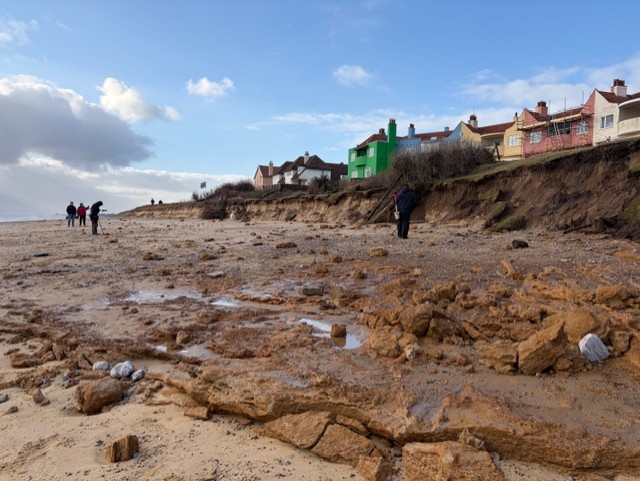
Thorpeness ‘beach’, 10th January 2026 Credit Fran Crowe
Note 1 Minutes of the Sizewell C Marine Technical Forum 2nd September 2025 – see para 5.07
Also see TASC press release 12th January 2026
Thorpeness was referenced in the Greatest Hits Radio article, ‘Campaigners warn coastal erosion could threaten Sizewell C site’ and ITV ‘Crisis meetings held with residents in coastal-erosion-hit Suffolk village as fourth home torn down’
Note 2 Extract from EN6:-
3.6.15 Based on the advice of the relevant Nuclear Regulators, the IPC should be satisfied that the applicant is able to demonstrate suitable flood risk mitigation measures. These mitigation measures should take account of the potential effects of the credible maximum scenario in the most recent marine and coastal flood projections. Applicants should demonstrate that future adaptation/flood mitigation would be achievable at the site, after any power station is built, to allow for any future credible predictions that might arise during the life of the station and the interim spent fuel stores.
3.6.16 Applicants should set out measures to mitigate the risk of flooding on or from individual sites that may result from the development, including any associated infrastructure such as possible marine landing jetties/docks. For further information on mitigation measures see Section 5.7 of EN-1
Together Against Sizewell C (TASC)
Dec. 22, 2025
Seasonal greetings from TASC

As the year draws to a close, TASC is extremely grateful to all our supporters for their continued dedication to our cause and offers our warmest wishes for a very merry Christmas, a peaceful holiday season and a happy new year.
2025 has been a tough year because of this government’s commitment to a final investment decision in Sizewell C. This enabled the project to proceed leading to the inevitable continued destruction of the environment, chaos and carnage on the roads affecting numerous communities and businesses due to the projects construction works. The year also started badly with the sad loss of TASC’s long-term Chair and inspiration, Pete Wilkinson. Pete’s family are very much in our thoughts, especially at this time of year.
TASC is, however, fortunate to retain some of the original objectors on our committee. They recall a meeting was first held in Leiston Cinema in 1989 to hear concerns about the Sizewell C proposals at that time! It was madness then and continues to be so. The two earlier applications: 1989 CEGB, for a single PWR and 1993 Nuclear Electric for two PWRs came and went but this EPR design for Sizewell C is a different matter altogether. Everyone opposed has worked so hard and tirelessly to see off the real threat it poses and the many factors which prove that the siting is farcical. The greenwashing, gaslighting and false reporting from the developer just exacerbates the situation. The Government is blind and blinkered to the appalling mess, both environmentally and financially, that the nuclear industry will leave for future generations.
Our legal challenge
Due to the recent High Court decision having been given verbally, the transcript of the judgement will not be available until the new year. Once the transcript is available, we will discuss our options further with our legal team to determine the best way forward.
TASC is still firmly of the opinion that Sizewell C’s secret additional sea defences should be assessed now and not delayed for decades, which is Ed Miliband’s intention. His stance is contrary to the government’s recent statement reported in the 18th December Guardian article, ‘Massive disruption: UK’s worst-case climate crisis scenarios revealed by scientists’, where the government spokesperson said “Climate change is at the heart of this government’s agenda, both adapting for the future and becoming a clean energy superpower…”. The Sizewell C DCO’s lack of provision for additional sea defences that EDF realised in 2015 would be needed in an extreme sea level rise scenario, coupled with the fact that nuclear power is not a ‘clean’ source of energy, is in direct contradiction of the government’s statement.
Local news
As advised in our last update, we had asked the new Energy Minister, Lord Vallance, to meet with the communities affected by the Sizewell C development, as no Labour Minister has so far. TASC were extremely disappointed to learn that Lord Vallance visited Sizewell C on 18th December totally ignoring our request. We will be expressing our disappointment to him in the new year.
Warning for 2026
Sizewell C published their ‘Project Update’ on 18th December listing their planned road closures and other works for the new year, meaning there will be even more chaos and disrupted journeys in 2026. Their documentation contains the usual gaslighting, claiming “…we work to improve the local road infrastructure” and “we aim to get works achieved ahead of the busy summer period for visitors”, seemingly oblivious to the fact that the new roads would not be needed if it were not for Sizewell C. As TASC have always said, these roads represent additional environmental damage, not improvements.
In TASC’s opinion, Sizewell C has made no attempt to make it easier for those who live in, work in or visit the area. Do they really expect visitors to come to East Suffolk next year when it has been devastated by this development? Sadly, we have first-hand knowledge of visitors’ distress at the state of this once precious place and the much-loved country lanes, footpaths and Heritage Coast. East Suffolk was renowned for its peace, tranquillity, wildlife value and landscape beauty but it is now difficult to believe that it could ever return to its former glory. Sad times, but we have no intention to give up the fight to protect it.
Biodiversity Net Gain
On 21st December East Anglia Bylines published an article by Rachel Fulcher, ‘Biodiversity Net Gain: can developers be trusted?’. An excellent article - we recommend it to our supporters.
“… When I learned that this woodland, known as Goose Hill and much loved by ramblers and bird-watchers, was to be entirely flattened and covered in concrete for a [Sizewell C] construction site, I was heartbroken.”
Many thanks to all those who continue to support our campaign - we will be updating you with our plans for 2026. In the meantime, all in TASC wish you a peaceful and happy Christmas.
Together Against Sizewell C (TASC)
Dec. 12, 2025
Disappointing news from the High Court
Together Against Sizewell C (TASC) are extremely disappointed to advise of today’s decision by the judge, to refuse permission for a judicial review in relation to Sizewell C’s secret additional sea defences.
In TASC's view, it is immoral to proceed with Sizewell C in the knowledge that the project, as approved in the development consent order, is not resilient to an extreme sea level rise scenario. This will result in future generations having to pick up the pieces from ill-thought out decisions made today.
Future generations need government to move forward with sustainable development, not questionable climate change solutions, such as Sizewell C, which come with hidden risks that have been denied public scrutiny, assessment and full consideration of alternatives.
TASC is really grateful to all of our supporters without whom we would not have been able to take this action. We will now be discussing our options with our legal team and will keep this page updated.
Together Against Sizewell C (TASC)
Dec. 10, 2025
High Court decision deferred
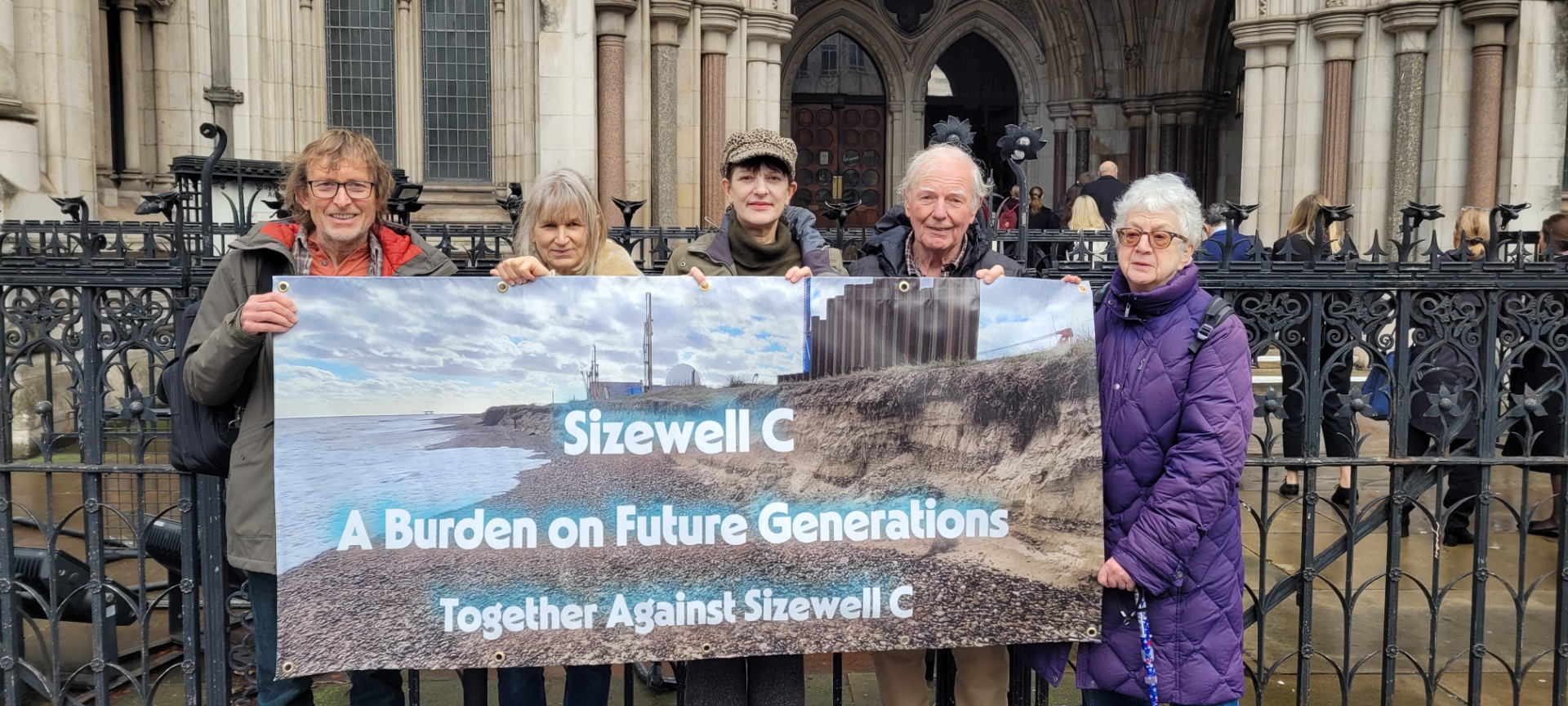
At Tuesday's High Court permission hearing the judge chose to defer announcing his judgement until Friday 12th December, so we will have to wait a bit longer to find out whether we have been granted permission to have a full judicial review hearing regarding Sizewell C’s secret sea defences.
We will provide an update when we know the outcome.
Thank you for your continued support.
Together Against Sizewell C (TASC)
Dec. 5, 2025
TASC's court hearing on 9th December
We are nearly there! Not long to go until TASC’s permission hearing at the High Court, London on Tuesday 9th December 2025. All are welcome to attend to hear TASC’s barrister, David Wolfe KC, present our legal case to the judge. We understand that the 2-hour hearing will start at 10.30am so we plan to meet up outside the High Court at 9.30 for a photo opportunity around 9.45am and allow sufficient time to get through court security. If you require further details, please email us at [email protected]
As you will be aware, coastal erosion and flood risk are at the heart of our case and TASC has continued our attempt to raise awareness with the various relevant authorities to the fact that the project, as approved in the Sizewell C (SZC) development consent order (DCO), is not resilient to a credible maximum sea level rise scenario, because EDF, although aware of their need in 2015, chose not to include the additional sea defences required to protect the site in that scenario, in their planning application. This is contrary to the requirements of the UK’s National Policy Statements and is in breach of the Habitat Regulations (HRA) which require assessment of the impacts of a project’s worst-case scenario on European wildlife sites.
The Secretary of State should not be allowed to put off the decision to assess the additional sea defences and consideration of alternatives to them – to do so could potentially make things worse for our descendants and the environment.
TASC’s ongoing work has included communicating with the Office for Nuclear Regulation (ONR), the Environment Agency (EA), East Suffolk Council (ESC) and the local MP.
On 6th October we met with officers from the Energy Projects team at ESC to discuss various issues including those relating our concerns about coastal erosion and flood risk at the SZC site – we followed this up on 31st October with an email to ESC’s Coastal Management setting out our concerns in more detail, this asking a number of questions including, “Please advise whether ESC share our concerns about the uncertainty of how long spent fuel will remain on the Sizewell C site and whether ESC consider the flood protection measures set out in the approved DCO are still capable of protecting the site from erosion and flooding in a credible maximum sea level rise scenario, till all spent fuel is removed - now said to be, by Sizewell C Ltd, 2160?”
On 19th November, along with other NGOs, we had a virtual meeting with the new DESNZ Nuclear Minister, Lord Vallance. At this meeting TASC made a general statement and verbally asked for a Labour minister to travel to East Suffolk to meet the communities impacted by Sizewell C (none have to date) and to witness the coastal erosion. Prior to the meeting questions were raised with DESNZ, including from TASC, “In light of:-
(i) Cefas, on behalf of Sizewell C Ltd, stating in para 5.07 of the minutes of the Marine Technical Forum meeting on 2nd September 2025 (note 1), "TD [Cefas, on behalf of SZC Ltd] explained that the northern end of the beach has shown a relative increase in erosion over the last few years, detected by the CPMMP drone flights, and that while not explicitly stated within the CPMMP SZC might wish to supplement the dune volume with additional sediment. TD explained that, on the basis of work detailed in the CPMMP, the area from approximately just south of the TMBIF to the northern SZC site boundary would benefit from additional material.” – this is before Sizewell C is even built,
(ii) Sizewell C Ltd finally admitting that spent fuel will remain on the Sizewell C site until at least 2160 (longer if a GDF is never built) not the 2140 date in the approved DCO,
(iii) Despite Essex & Suffolk Water having a consultation out, Sizewell C still haven’t secured a sustainable supply of potable water essential for its 60 years of operation,
(iv) Rapid coastal erosion witnessed at nearby Thorpeness where 23 metres of cliff has been lost to the sea over the last 12 months and properties are having to be demolished (note 2),
Does the minister consider that Sizewell C, as approved in the DCO, is resilient to a credible maximum climate change scenario?
Note 1 Minutes of the Sizewell C Marine Technical Forum, 2nd September 2025 - see para 5.07 https://www.eastsuffolk.gov.uk/assets/Planning/Energy-Projects/Sizewell/Governance/02-September-2025-Marine-Technical-Forum-Meeting-Minutes.pdf
Note 2 BBC article, 'Demolition of home on eroding coastline begins', 28th October 2025 https://www.bbc.co.uk/news/articles/cvgv3ly9gy8o
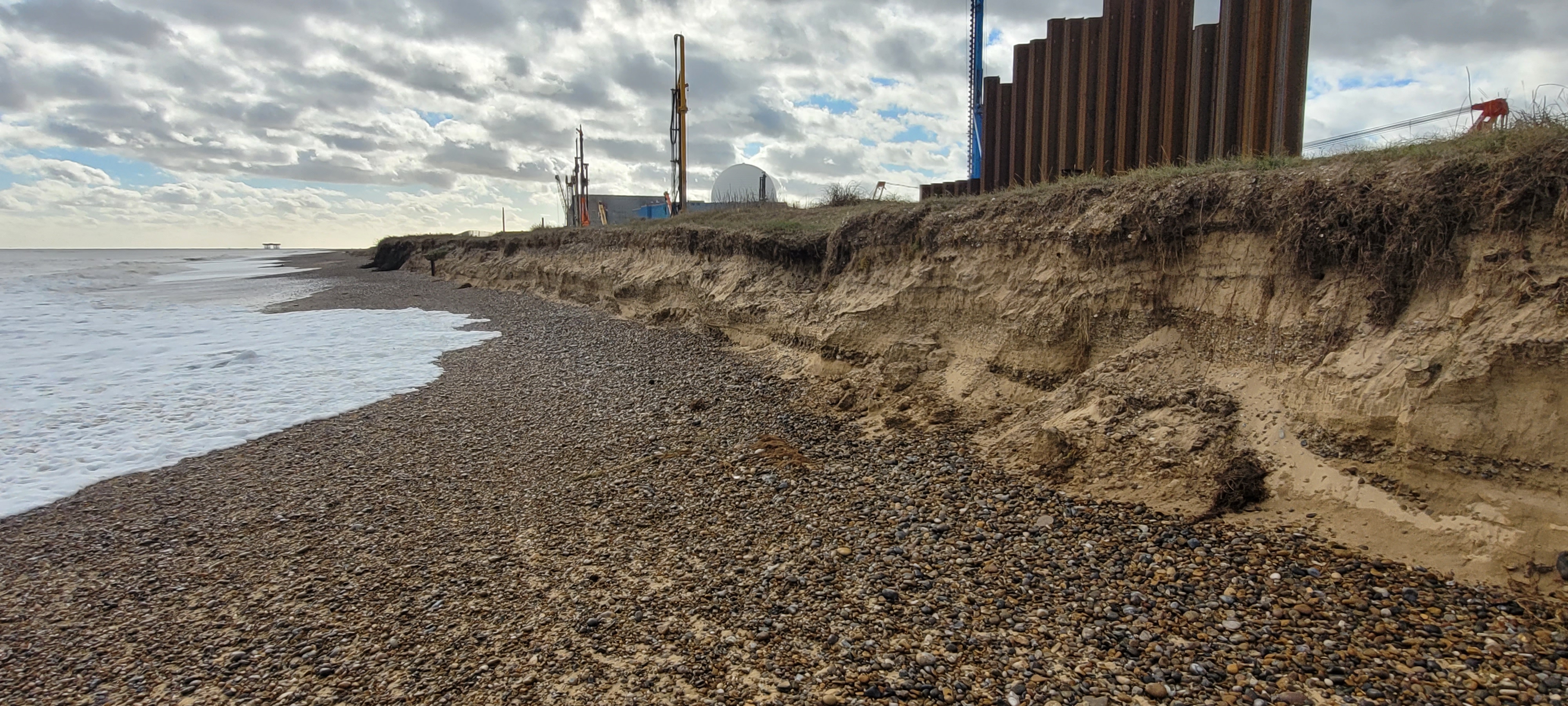
Image: eroded coast in front of Sizewell C, 24th October 2025
__________________________________________________
Following our questions to Lord Vallance, on 26th November we wrote to Suffolk Coastal MP, Jenny Riddell-Carpenter, asking her to support our request to him, “TASC have grave concerns about the environmental and financial burden that this government is placing on future and far future generations in order to keep Sizewell C and its spent fuel safe till the late 2100s and this needs to be recognised. For their sake, TASC would be grateful if you will support our request for Lord Vallance to visit East Suffolk to meet with communities affected by the Sizewell C project and to witness first hand the erosion at Thorpeness and Sizewell. Particularly as no Labour Minister has come to East Suffolk to meet the affected communities and listen to their concerns, something that even the previous Conservative government managed to arrange.”
Our work with the ONR included a recent Freedom of Information (FOI) request for more up to date information regarding site suitability and the results of recent coastal studies. We also attended a Nuclear NGO Forum meeting at the ONR’s headquarters in Liverpool on 26th November and met the new Chief Nuclear Inspector, Mike Finnerty. During our lengthy conversation with him, the NGOs were told that there would be no reduction in nuclear safety following the publication of the Nuclear Regulatory Taskforce’s report that has recommended radical reforms to the nuclear regulatory regime – only time will tell whether this confirmation holds true but what is certain is that the report’s recommendations will bring about far less protection for our precious wild spaces and the wildlife that inhabit these areas. Also, there are troubling recommendations to reduce the ability for communities and NGOs to take legal action against nuclear projects and to increase the legal costs for NGOs. There are also proposals to increase the existing limits that protect exposure to ionising radiation. With Keir Starmer announcing his support for all the Report’s recommendations, it will be the nuclear industry and big business that will benefit from these changes to the detriment of ‘working people’, the general public and the environment. The Taskforce’s 47 recommendations can be found on pages 144 to 148 of the report. What is certain, is that there are difficult times ahead!
______________________________________________________
A recommended excellent read is the recent Guardian article by veteran journalist, Paul Brown, ‘‘I have watched politicians failing yet and yet again’: lessons from a life as an environment writer: Paul Brown looks back at his career reporting on the climate crisis, failed summit and nuclear power – and how to do it well,
“Over the years I have regularly been fed wildly optimistic figures of construction costs and times and of the resultant electricity supply. At worst we have been consistently lied to. Unlike wind and solar, nuclear costs have consistently gone up for decades.
And now it is happening all over again at Sizewell C in Suffolk and in north Wales; the British public is being forced to watch as the government pours billions of pounds of our money down the drain. Journalists should be exposing this terrible waste. In the name of the climate I ask them to look closely at the real facts, not believe the hype, and try to stop this waste of resources before it gets worse.”
Local news: As those that live in or visit East Suffolk will testify, Sizewell C’s new road infrastructure is causing chaos and collisions. A BBC report on 26th November provided a warning to avoid Sizewell C‘s roadworks on the A12 junction with A1094 at Friday Street following great work from local Independent Councillor Jules Ewart. In other places road closures, traffic lights and construction traffic are causing chaos on many local roads leading to great frustration for those going about their normal daily lives.
______________________________________________
TASC urgently need help to reach our crowdfunding target in order to continue with this important legal action. We are extremely grateful to all who are able to contribute to and/or share our Crowd Justice page.
Together Against Sizewell C (TASC)
Oct. 19, 2025
TASC have a court date
Save the date – Tuesday 9th December 2025 has been set for TASC’s permission hearing at the High Court, London. The timing of the hearing will not be known until a day or two before 9th December, but all are welcome to attend to hear TASC’s barrister, David Wolfe KC, present our legal case to the judge. As soon as we know the time of the hearing, TASC will provide the details.
Coastal erosion and flood risk are at the heart of our case and the Guardian article of 15th October, ‘UK must prepare buildings for 2C rise in global temperature, government told’ highlights that our government needs to ensure, “Any new constructions intended to last decades should be prepared for 4C above preindustrial levels – a level at which the world will face global devastation.” In our opinion this clearly indicates that Sizewell C needs a major rethink/cancellation, not just because of the risks of coastal erosion and flooding but also drought – TASC and other NGOs were advised by DESNZ at a recent meeting that Sizewell C still haven’t secured a contract for the supply of the average 2.2 million litres per day of mains water essential for its slated 60 years of operation.
It comes as no surprise to those that know the vulnerabilities of the Suffolk coast and the Sizewell site to read in para 5.07 of the minutes of the Sizewell C Marine Technical Forum meeting on 2nd September 2025, “TD [Cefas, for Sizewell C Ltd] explained that the northern end of the beach has shown a relative increase in erosion over the last few years, detected by the CPMMP drone flights, and that while not explicitly stated within the CPMMP SZC might wish to supplement the dune volume with additional sediment. TD explained that, on the basis of work detailed in the CPMMP, the area from approximately just south of the TMBIF to the northern SZC site boundary would benefit from additional material.
SR [for Sizewell C Ltd] stated that the project was looking into this, but nothing was planned as yet. SR confirmed that if “recharge” was performed it would be entirely above the MHWS mark (and therefore would have no Marine Licencing implications) but would require a Flood Risk Activity Permit (FRAP). SR also confirmed that, as per the final SCDF, any material used would be “site-won” if possible and of the same modal particle size.” So, Sizewell C are already admitting they may need to recharge the beach before the plant has even been built – in our opinion this calls into question the viability and sustainability of the project, adding to the probability that the additional sea defences, the subject of our legal case, will be needed in the future.
The problem of long-term management of the spent nuclear fuel that will be generated by Sizewell C in particular, and new nuclear generally, is answered by government and the nuclear industry by virtue of their aim for there to be a ‘geological disposal facility’ (GDF) to store the waste underground. The Sizewell C DCO was approved on the basis that its spent fuel would be transferred to a GDF by 2140, but Sizewell C later admitted that the earliest this could happen is actually 2160. However, in August 2025 the H M Treasury unit, Nista, published its annual assessment of UK infrastructure projects in which they advised that their January 2025 assessment of the GDF concluded that the project was ‘unachievable’ and ‘unaffordable’. Furthermore, The Nuclear Decommissioning Authority’s Annual Report says, “Management has identified a risk that the construction and opening of the GDF may be delayed beyond 2050.” [page 180]. At the last Nuclear Waste Services(NWS) Exchange, NGOs were told NWS intends to review the GDF Business Case in the hope of achieving an Amber rating for the project in the next Nista Assessment. The GDF is not on the same growth trajectory following the recent spending review, so when the business case is reviewed there is a strong possibility that the completion date will move again. As spent fuel from older power stations will be moved to a GDF first, the implication for Sizewell C is that its spent fuel may not be able to be moved into a GDF until the very late 2100s. This means that the Sizewell C site will need to be protected for a much longer period than 2160 that is currently proposed, thereby increasing the likelihood that the additional sea defences will be required. Alternatively, the spent fuel would have to be moved to a new location.
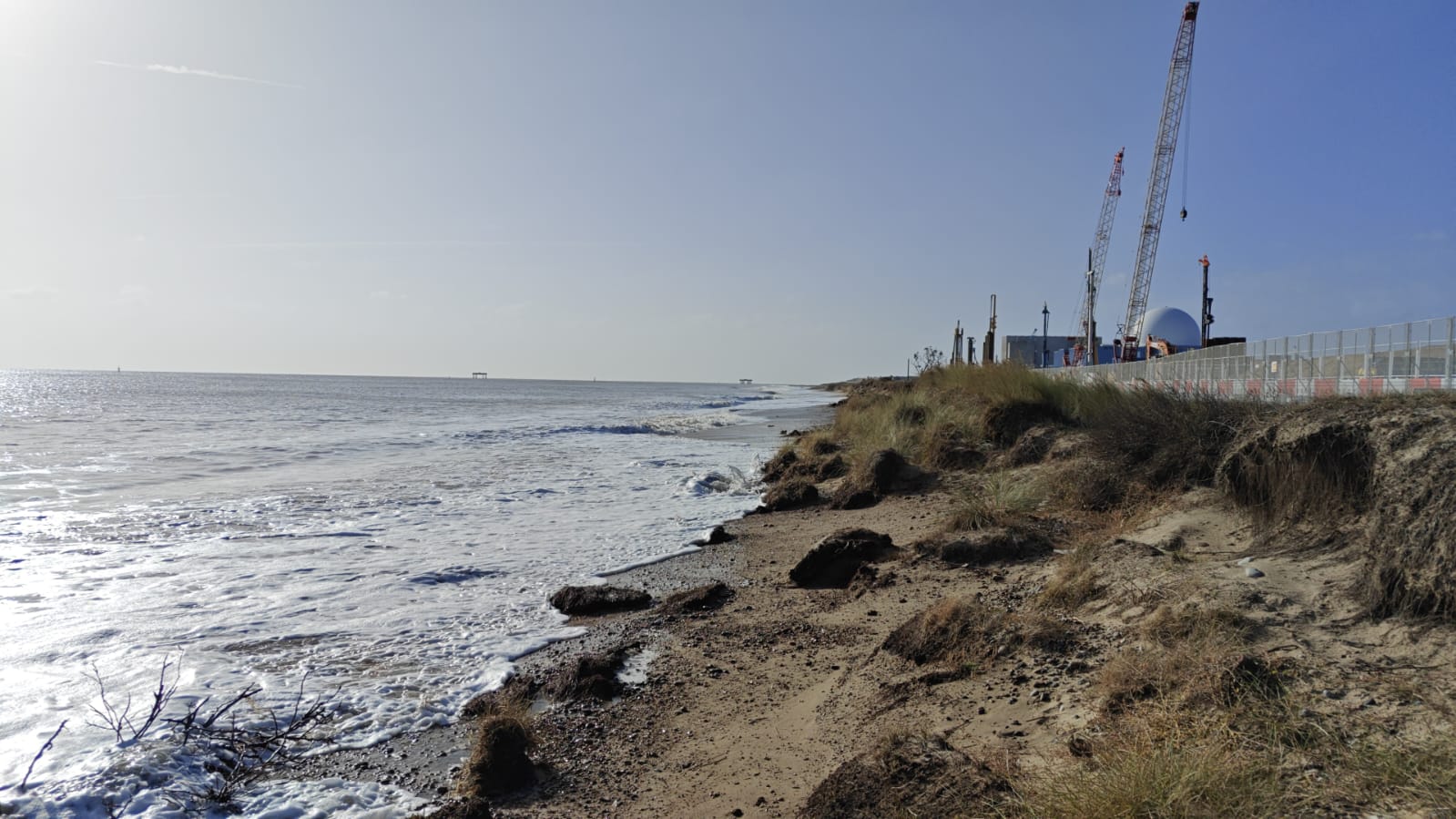
Picture of the coast in front of Sizewell C after October 2025 storm
TASC still need help to reach our crowdfunding target in order to continue with this important legal action. We are extremely grateful to all who are able to contribute to and/or share our Crowd Justice page.
Just a short distance south of Sizewell, owners of 18 coastal properties in Thorpeness have been given notice that in the event the cliff erodes to within 5 metres of their homes then the house will need to be demolished. The problems at Thorpeness were reported by various media outlets, including the BBC on 20th August 2025, ‘My heart would break if I lost my home to the sea' which stated, “After another home in her street was demolished in 2022, Ms Flick feared she could lose her home too. She added that Storm Babet in 2023 had "really ravaged" the cliffs.”
The situation at Thorpeness is another reminder of the vulnerability of the Suffolk coast to erosion and flooding, including the Greater Sizewell Bay in which Sizewell C is located.
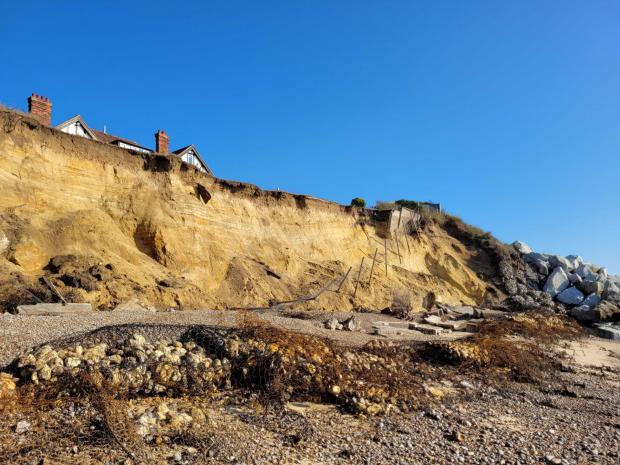
Image August 2025: rapid erosion of the cliffs at Thorpeness
In November, most of us will start paying the nuclear tax, RAB, to help fund the construction of Sizewell C. The media have picked up on some of the impacts, including the Guardian, ‘UK small businesses and charities say nuclear levy could add thousands to bills’, which said, “The extra charge could mean a significant cost hike for charities and small businesses with high energy use, meaning community services may be cut and economic growth curtailed, according to trade groups. For most charities, the levy, which takes effect in November, will mean an increase in costs of between £100 and £240 a year, but some could experience increases of up to £2,500”. However, energy intensive industries such as steel making will be exempt from RAB, demonstrating, yet again, this government’s propensity to favour certain large corporations over households, charities and small businesses.
This government has continued its assault on those trying to protect the environment and those that have concerns about the impacts of infrastructure projects such as Sizewell C. Following on from Keir Starmer’s February announcement, ‘Government rips up rules to fire-up nuclear power’ the Nuclear Regulatory Taskforce was set up with a remit to deregulate the nuclear industry. Rather belatedly, the Taskforce decided to consult with the NGO community about the Taskforce’s interim report to government. TASC, individually as well as in conjunction with the NGO community, submitted responses which can be read here. In TASC’s initial response dated 8th September we wrote, “…we are of the opinion that the government’s request for the Taskforce’s review is starting on a false premise that nuclear is ‘clean energy’ [see Note 1] and ‘needed to power Britain’s future’ [see comment below re page 7]. Neither of these assertions stand up to public scrutiny, this review being driven by the nuclear industry, big business and lobbyists for commercial and ideological reasons. TASC draw your attention to the Guardian article ‘Starmer ignored nuclear watchdog when he blamed regulations for delays: Office for Nuclear Regulation told government that claims about reactor delays in press release were not true’ which undermines government claims that project delays are largely caused by regulations and the regulators.”
In TASC’s second response dated 23rd September, we tackled the false claims made regarding the length of time Sizewell C was delayed due to legal challenges - “It is totally without foundation to say that the Sizewell C project has been held up for 827 days (approx. 2 years 3 months) due to judicial reviews. Indeed, DCO approval was given in July 2022, preparatory works started in 2023 and the DCO was triggered in January 2024. If the project was behind schedule, why did Sizewell C Ltd’s joint managing directors advise Parliament in January 2025 that, "Sizewell C is on time and on budget and has a stable cost base.”
In the joint NGO submission the group said, “The UK's nuclear regulatory system has worked well for sixty years to ensure the safety of a high hazard industrial sector. In our view the system is not broken and does not need fixing, and frankly it would be counterproductive to make substantial changes to its operation for the convenience of the nuclear industry.”
In HM Treasury’s press statement, ‘Chancellor takes on the blockers to get Britain building’ dated 15th October, Rachel Reeves chose to continue with divisive and insulting rhetoric when she announced new proposals to fast-track major infrastructure projects totally disregarding the fact that delays and legal challenges are caused by developer incompetence and poor projects.
On a more positive note, local campaigner, Mandy Beaumont, has managed to prevent Sizewell C from felling 6 out of 8 mature oak trees alongside the B1125 in Middleton. Potentially, all 8 oak trees can be saved if the road layout can be altered – see EADT article of 1st October.
Many thanks from TASC for your continued support, it is very much appreciated.
Together Against Sizewell C (TASC)
Aug. 3, 2025
GOOD NEWS - TASC SECURE A COURT HEARING
Good news - TACS’s JR claim calling for Sizewell C’s development consent order to be revoked or varied has been granted a permission hearing in the High Court. At a date to be confirmed, a judge will hear why we consider it is unlawful to delay, for decades, assessment and public scrutiny of two huge additional flood defences kept secret by EDF since 2015. If the court grants permission, then we shall have a full judicial review hearing in due course.
Now this government has made a final investment decision for Sizewell C, committing a minimum of £17bn, but potentially risking as much as £54.5 billion, of public funds to the project, it is imperative that its resilience to extreme climate change events is assessed now. If not, the opportunity to consider alternatives to the additional flood defences e.g. raising the platform height, will be lost.
We have already burdened future generations with the climate crisis – so called solutions such as Sizewell C should not be allowed to add to that burden. Sizewell C will produce 4,000 tonnes of radioactive spent fuel that will need to be kept safe on Suffolk’s eroding coastline till the late 2100s, it must not be permitted to place a further environmental and financial encumbrance on future generations by leaving them with the responsibility to assess and build these additional sea defences.
Sizewell C’s attempt to avoid scrutiny of these additional sea defences now, means the project is proceeding without its full environmental impact having been assessed, this being in contravention of the UK Habitat Regulations. Sizewell C clearly believe they can do as they see fit with our Heritage Coast, National Landscape and designated wildlife sites irrespective of the damage they will cause – this government, the largest shareholder in Sizewell C, must be challenged on this.
TASC urgently need help to reach our crowdfunding target in order to continue with this important legal action. We are extremely grateful to all who are able to contribute to and/or share our Crowd Justice page.
Estimated position of Sizewell C’s southern and northern flood barriers (original images courtesy of Google Earth):- 
 .
.
Together Against Sizewell C (TASC)
July 23, 2025
Sizewell C update on High Court application & FID announcement
TASC are still waiting to hear from the High Court as to whether we have been granted permission for a judicial review hearing – TASC submitted the formal application to the court two months ago and then one month later filed our response to the ‘Grounds of Resistance’ that had been submitted by the Secretary of State for DESNZ and Sizewell C Ltd.
You are no doubt aware of yesterday’s appalling news that the government has made a final investment decision (FID) on Sizewell C and revealed the latest estimate for the cost of building the plant as £38bn {2024 prices]. Government has now confirmed what we have all known for years - that the cost of building Sizewell C will be far higher than the £20bn they and Sizewell C Ltd have been claiming for the last 5 years - so, it is not just the additional sea defences that EDF and Sizewell C Ltd have chosen to keep secret! One wonders what else they are keeping hidden.
Now there has been a formal financial commitment to Sizewell C, it is imperative that our legal claim is heard by the court because the full environmental impact of the project has not been assessed nor have alternatives, such as raising the platform height (negating the need for additional flood defences), been considered and given public scrutiny. Future generations are relying on us to get this right.
The Sizewell C FID establishes the project’s ownership as: UK Government 44.9%; Canadian pension fund, La Caisse 20%; Centrica 15%; EDF 12.5% and Amber Infrastructure 7.6%.
In order to get this risky project over the line, this government has chosen to burden the UK public with paying the Sizewell C construction tax (Regulated Asset Base funding model) - expected to be added to our electricity bills over the next few weeks - and take on the risk of cost and time overruns. This decision prioritises big business and props up French state owned EDF and their ailing nuclear industry, rather than more deserving causes in the UK.
An example of the high returns that investors are expected to make at our expense was reported in the Financial Times, "Centrica said it still expected to make 10-12% returns even if the project comes in at £47bn. If costs climb above £47bn, investors have no obligation to inject more equity."
Many supporting documents have been published by government so, we are anticipating that further details regarding the substance of the government arguments in favour of Sizewell C will be revealed as we scrutinise these reports over the coming days. The value for money assessment, para 14, includes justification for Sizewell C, stating, “The Net Present Social Value (NPSV) has been calculated by comparing the cost of the electricity system with and without SZC. It includes costs that have already been incurred by the project…” In TASC’s opinion, this sort of argument is straight out of the HS2 playbook – the reckless decision to throw billions of taxpayer funds at Sizewell C before a FID has been used to justify continuing with the project.
TASC issued the following press statement following the FID announcement:-
Following Ed Miliband’s statement that a final investment decision has been made regarding the Sizewell C nuclear plant, Together Against Sizewell C (TASC) Chair, Jenny Kirtley, said,
“This decision is a financial and environmental disaster for the UK and a betrayal of future generations. We are in a climate crisis that needs immediate action, yet this government has chosen to squander billions of public funds on a project that will not be operational until the late 2030s and has already seen a staggering 90% uplift in cost over the last 5 years. At nearly double the original £20bn price tag, a figure still being touted by joint managing director Julia Pyke until recently, how can anyone believe that £38bn Sizewell C will provide ‘value for money’ for consumers and taxpayers. The scale of potential exposure of public funds to the Sizewell C project is revealed as a staggering £54.589 billion in the government’s FID subsidy scheme (see note 1).
“So much for claims made by EDF and government that there would be huge cost savings from ‘lessons learned’ from the Hinkley Point C build. In TASC’s view, the cost of this risky project can only increase as there are still many unresolved issues, including the recently revealed hidden sea defences which were not included by EDF in the 2020 DCO planning application even though EDF knew they would be needed in 2017 (see note 2). Future generations will have the responsibility to protect the Sizewell C site until the late 2100s and are depending on us to get it right.”
Notes:
1. https://searchforuksubsidies.beis.gov.uk/scheme/?scheme=SC11357
2. Leigh Day’s press release regarding TASC’s legal challenge about Sizewell C’s secret sea defences.
TASC are extremely grateful for your continued support, it is much appreciated.
Together Against Sizewell C (TASC)
June 29, 2025
Sizewell C’s secret flood defences - an update
Further to the start of this Crowdfunder, quite a lot has happened in relation to Sizewell C
You are probably aware that, irrespective of previous government statements, a final investment decision (FID) for Sizewell C was not made during Rachel Reeves' spending review on 11th June.. Instead, on 10th June there was yet another announcement advising that the project was ‘going ahead’, with this government promising to splurge a further £14.2 billion of public funds on Sizewell C, over the term of the current parliamentary period to 2029, this including the £2.7 billion previously announced for the 2025/26 financial year. Noticeably, as there was no FID uncertainty remains with suggestions that FID will happen at the Anglo-French conference on 8th July. Despite this uncertainty, the project continues to progress by stealth.
However, on Friday 27th June, media reports about the possibility of Centrica taking a 15% stake in Sizewell C stated, “All sides are keen to reach a final investment decision on the project before parliament's recess on July 21.” Centrica have said they would only invest if the returns were good enough and financial exposure is capped so in our view if they do take a stake in Sizewell C, the UK taxpayer and consumer will have been sacrificed by this government to take on project risk, higher electricity bills and other unforeseen costs. But it’s not just the current generation that will suffer from Sizewell C. Future generations will be responsible for keeping the site safe for its full lifetime, to 2160, including the potential construction of two huge additional sea walls, the impacts of which have not been assessed because this government is choosing to keep them hidden from public scrutiny. This is despite the British public effectively owning Sizewell C through the government’s 88% stake in the project. The government’s failure to address our concerns left TASC with no alternative but to initiate legal action against them, details of which are set out in the press release from our lawyers, Leigh Day
This government is clearly determined to push on with Sizewell C regardless. It is imperative TASC’s new legal challenge gets a court hearing, whether there is a FID or not, to ensure consideration is given to Sizewell C’s planning permission being either revoked or varied to allow public scrutiny and assessment of the additional sea defences, their impacts and alternatives, such as raising the platform height (a higher platform height could negate the need for the additional sea defences). Without this, the Sizewell C project cannot show it conforms with National Policy Statements which require projects to demonstrate resilience to extreme climate change impacts.
TASC is extremely grateful to all who are able to donate to, and/or share details of, this important new fundraiser.
P.S. Following the government’s U-turns on winter fuel allowance and cuts to disability benefits through their welfare reforms, we wait to see how Keir Starmer now justifies the funding of Sizewell C following his message on X (twitter) on 11th June.
Get updates about this case
Subscribe to receive email updates from the case owner on the latest news about the case.

Recent contributions