NHS Workers v Health Secretary: Stand Up For Palestine
NHS Workers v Health Secretary: Stand Up For Palestine

Latest: July 25, 2026
The BMA cites our legal opinion in urgent request to NHS England
Yesterday, the BMA wrote to NHS England calling for a pause in the implementation of the IHRA definition, for consultation, and for legal analysis of the risks by every NHS Trust. The BMA expressly d…
Read moreNHS Workers v Health Secretary: Speak Out On Palestine
Healthcare workers have a fundamental right and ethical duty to speak out against atrocities and war crimes - but that right is now under threat. Your support will fund expert legal representation seeking to defend freedom of expression in healthcare and challenge discriminatory policies that target pro-Palestinian voices.
Who We Are
We are Health Workers 4 Palestine (HW4P), a grassroots organization of health workers determined to speak out against the illegal occupation and war crimes perpetrated by the Israeli government against Palestine. Our executive team and strategic advisors include individuals with significant experience of healthcare provision in the UK and directly to the Palestinian people.
The Challenge
HW4P has instructed a leading human rights law firm to investigate and seek to pursue legal challenges against NHS England's decision to adopt the International Holocaust Remembrance Alliance (IHRA) working definition of antisemitism.
While antisemitism must always be condemned, the IHRA definition has been criticised by many leading human rights, academic and civil society groups (including the PSC and Jewish community organisations) for its ambiguity and tendency to conflate criticism of Zionism or the State of Israel with antisemitism. ELSC has reported on the IHRA definition's adverse impact on Higher Education. The introduction of the definition into the NHS risks creating a chilling effect on the free speech and expression of staff who speak about violations of humanitarian law or advocate for Palestinian health rights.
Even before the Health Secretary’s recent policy changes, health workers have been targeted for the "antisemitism" of their Palestinian identity. To give just one of many examples, a British Palestinian nurse was threatened by a senior NHS executive simply for displaying an "antisemitic watermelon" amongst other fruits in his virtual background during an online meeting. This incident happened at a hospital which serves the Health Secretary's local community. We are dismayed that healthcare leaders have failed to speak up against anti-palestinian racism and the weaponization of "antisemitic fruit" against NHS staff.
Why confining antisemitism to the IHRA definition is problematic
1. Rigid and limited scope – The IHRA definition relies on 11 “contemporary examples” of antisemitism, 7 of which relate to speech concerning Israel. These rigid examples can be misused to characterise legitimate democratic debate as hate speech whilst overlooking or minimising instances of antisemitism not relating to Israel. Last year, Diaspora Alliance challenged the Department for Education’s decision to adopt the controversial definition as the ‘cornerstone’ of its proposed training programme for schools, colleges and universities.
2. Unequal treatment among forms of discrimination – We are concerned that the IHRA definition isolates antisemitism from other forms of discrimination whilst also minimising the importance of discrimination against other groups.
3. Lack of objective data – As far as we know, NHS Trusts do not routinely record data on allegations of antisemitism, islamophobia or anti-palestinian racism. NHS discrimination policy should be evidence-driven, not politically expedient.
4. Chilling effect on speech – Under the IHRA framework, health workers opposing Gaza’s destruction by Israel risk being labelled antisemitic, creating fear and self-censorship. This undermines their professional and ethical duty to speak out against humanitarian violations.
5. Diverting scarce resources – Implementing the IHRA definition in all its ambiguities through training, monitoring, and compliance, which will likely lead to litigation, will divert scarce NHS resources from patient care. We think it will result in a more polarised environment for health workers, to the detriment of healthcare provision for those who need it.
Future Challenges
HW4P is deeply concerned about the approach that has been taken regarding issues related to Palestinian advocacy more generally within the health system. We are therefore not only seeking legal advice on the NHS’s proposed adoption of the IHRA definition. We are asking our lawyers to investigate what legal avenues may be available to address a range of issues, including but not limited to (1) changes of policy and guidance regarding uniforms in the NHS and (2) what appear to be political interventions in the function of the independent medical regulator. Healthcare workers should not be a target in Palestine or in the NHS.
Conclusion
HW4P are concerned that NHS England’s decision to adopt the IHRA definition, its uniform policy review and apparent political interference by the Health Secretary in independent tribunal processes together represent a coordinated effort to suppress legitimate advocacy and free expression within the NHS.
Such measures threaten not only Palestinian human rights but also the moral foundations of healthcare itself. NHS staff must be free to defend life and dignity without fear of punishment for compassion or conscience.
HW4P stands firm in defending that principle - and we invite your support to take vital legal action. Your contribution will help protect freedom of expression, equality, and the humanity of those who care for others.

Health Workers 4 Palestine
July 25, 2026
The BMA cites our legal opinion in urgent request to NHS England
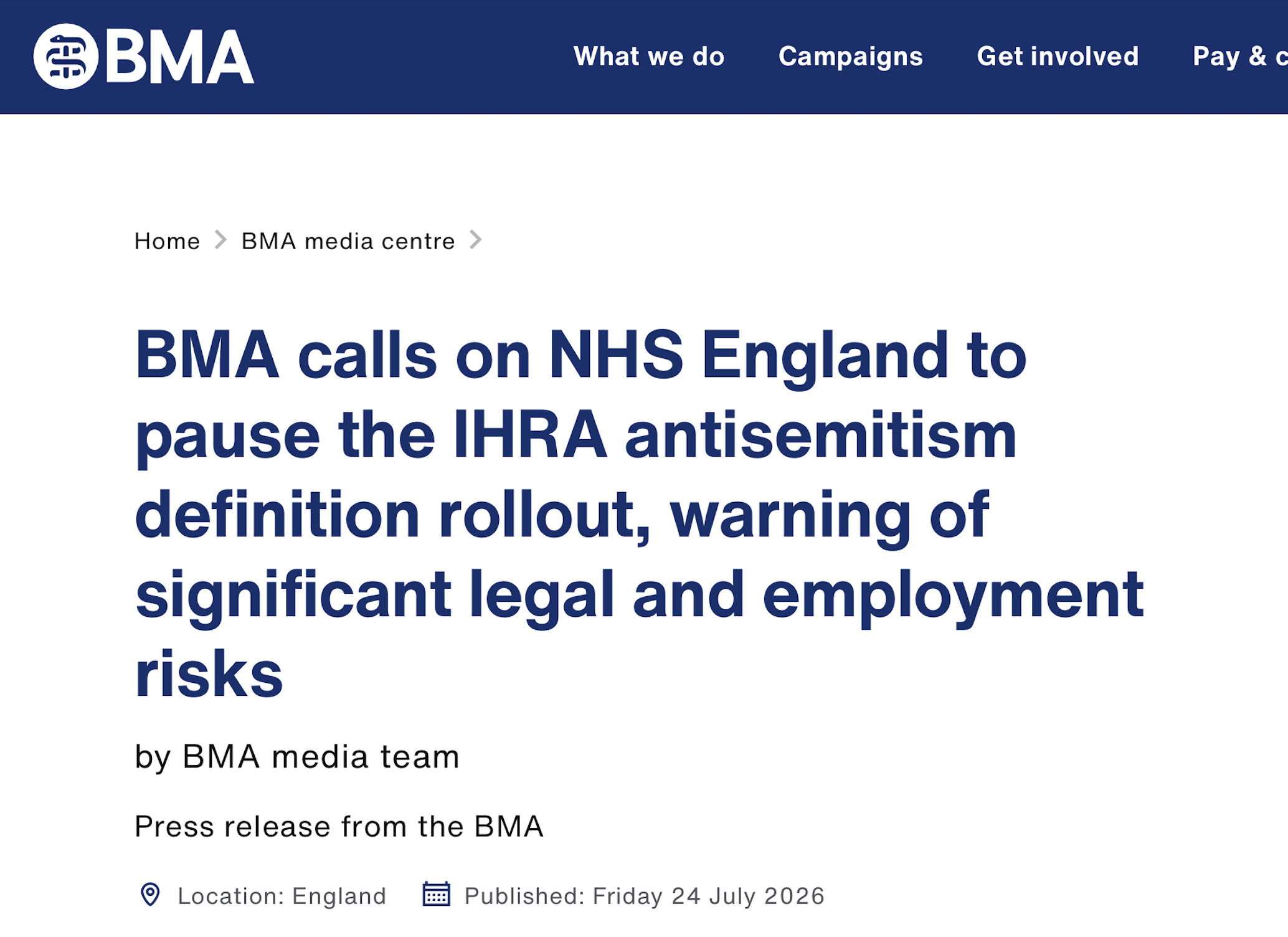
Yesterday, the BMA wrote to NHS England calling for a pause in the implementation of the IHRA definition, for consultation, and for legal analysis of the risks by every NHS Trust. The BMA expressly drew NHS England's attention to the legal opinion you funded through HW4P's crowdjustice campaign.
It's a very powerful letter from the BMA. You can read it here:
Health Workers 4 Palestine
July 21, 2026
Legal Opinion sets out risks of the IHRA definition in the NHS
HW4P has commissioned this landmark legal opinion. It provides the first comprehensive and authoritative analysis of the legal, equality, employment and human rights implications and risks arising from the adoption of the IHRA definition by NHS organisations, and explains why NHS bodies are under no legal obligation to adopt it.
Our legal team at Leigh Day have now sent this to NHS Trust chief executives across England.
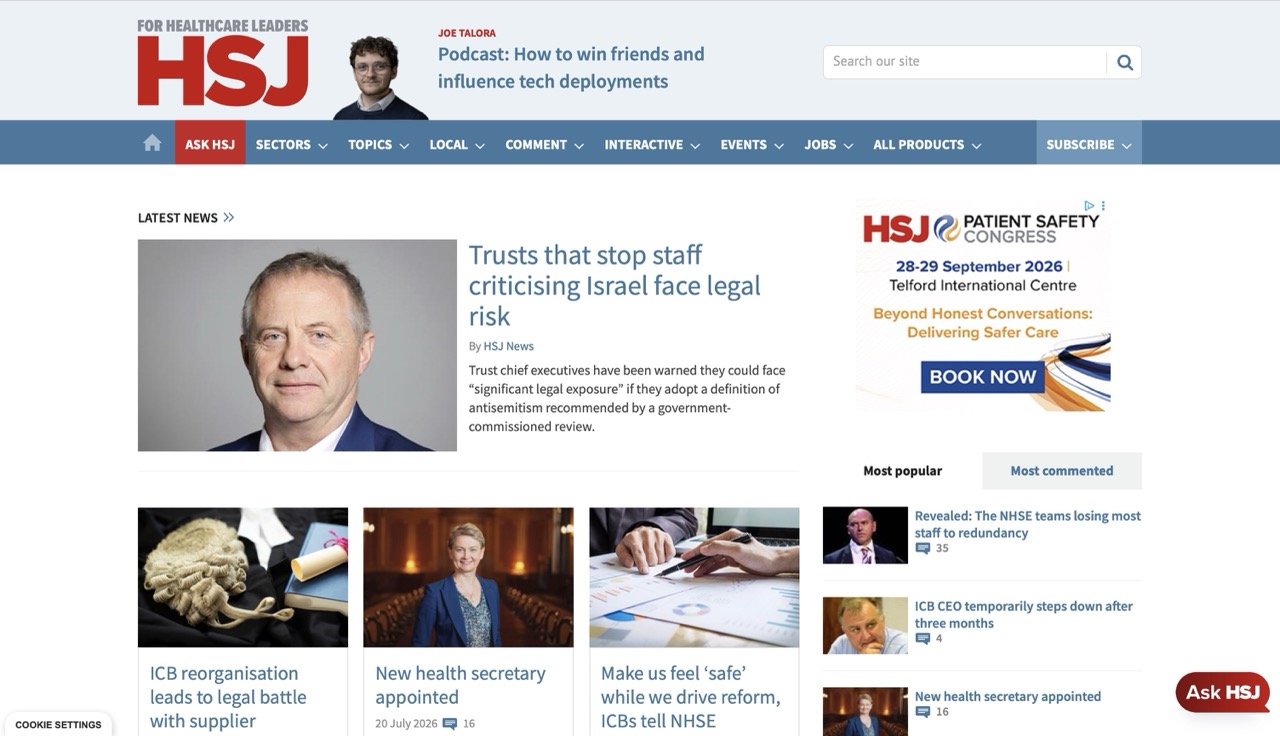
On the day that a new health secretary is appointed, the Health Service Journal gave the headline story to Kaufmann KC's legal opinion.
Recent contributions