Help stop residents becoming collateral damage in planning decisions
Help stop residents becoming collateral damage in planning decisions

We are raising £35,000 to take St Albans Council to the High Court over its approval of Taylor Wimpey’s reserved matters application in Chiswell Green.
We urgently need your help to get this case to the hearing.
When outline planning permission is granted, residents are often told, “Don’t worry - the details will be dealt with later.” But when later comes, those details can be treated as little more than a formality.
For the people who already live beside a major development site, reserved matters are not minor details – they are details that matter enormously. They decide where new houses are built, how close they are to existing homes, what residents will look out onto every day, and whether their privacy, light, amenity and day-to-day lives will be properly protected.
This case starts in a village called Chiswell Green, but it matters far beyond one village.
This is an issue that communities across the country facing major development pressures will recognise. Local people engage with the planning system because they understand the real-world impact of development proposals on the places they know intimately. However, too often, the impacts they warned about become the consequences they are left to live with once development moves from paper plans to construction on the ground.
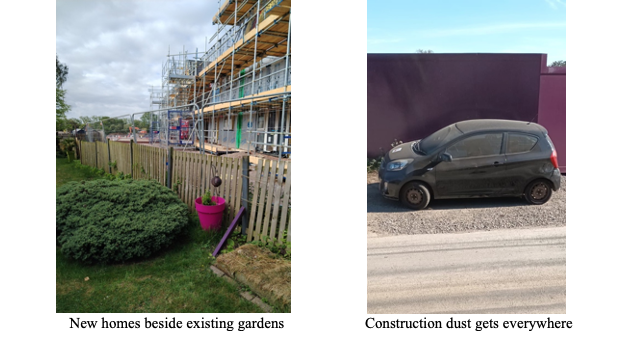
Across St Albans District, this is evident in areas such as Colney Heath, Park Street and North St Albans. By the time residents can point to the dust, noise, flooding, lost trees, overlooking and disruption, it is often too late. The plans have been approved. The diggers are on site. The harm has moved from application drawings to people's lives.
Once the principle of development has been approved, reserved matters and detailed approvals may be the last meaningful chance to secure protections before residents are left living with the consequences.
We believe St Albans City and District Council is failing residents at this crucial stage of the planning process where the real-life impact of major development is being locked in.
One resident living beside the Taylor Wimpey's development described the reality of daily life:
"What's it like living by the Rose Meadows construction site? Put simply, it's like living in a digger-themed amusement park, without the amusement.
There is a total disregard for residents and their right to a family and private life. Deliveries of aggregate and topsoil send up clouds of dust, so the garden is unusable when the site is operational. Where there used to be birdsong, there is now the incessant bleeping of reversing machines."
Another residents said:
"We're living with dust, builders looking straight into our homes from only a few feet away, and constant noise when we're trying to work. In this heat, it's even worse."
This is what happens when the impact of major development moves from paper plans to people's lives.
Who we are
Keep Chiswell Green is a residents’ group representing the village of Chiswell Green, near St Albans, in the Metropolitan Green Belt.
We came together in 2022 to oppose two major development applications for 721 new houses on Green Belt land. Since then, our village has faced a wave of speculative applications, including more than 1,500 proposed new homes, a solar farm, a data centre and a football stadium.
For more than four years, we have fought to protect our village, our Green Belt and the residents who live beside these major development sites.
What this case is about
Taylor Wimpey has permission to build nearly 200 homes on Green Belt land in Chiswell Green. Our legal challenge concerns the Council’s subsequent approval of the detailed reserved matters application.
In our case, residents raised serious concerns about the impact on existing homes. Some of the new houses were extremely close to existing properties. Residents highlighted the loss of privacy, loss of light, the risk of flooding, the unnecessary removal of mature trees and hedges that had helped to screen existing homes, and the long-term impact on their quality of life.
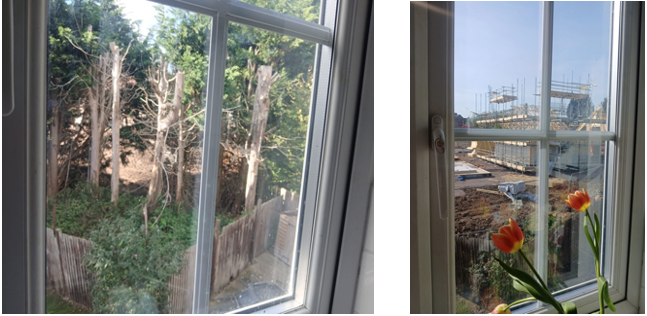
Before After
Residents were not trying to stop every house being built. They accepted that development was coming. What they wanted was a fair process, a better design, and proper protection for the people already living there.
Local policies and the Neighbourhood Plan were supposed to matter. Residents highlighted the need for homes that would meet local priorities - homes that would allow local people, young families and older residents to remain in their community - but those policies appeared to have been brushed aside when the detailed scheme came forward.
We believe that councillors wanted to secure stronger protections for residents before approving the application, but that they were not properly advised about the powers available to them to ask the developer to make changes.
This is extremely important. Elected councillors can only make lawful and fair planning decisions if they are properly advised. If they are led to believe that they cannot insist on proper protections for residents, then the democratic planning process becomes little more than a formal approval of recommendations that residents and councillors have had little real opportunity to challenge. When that happens, decisions made in public by elected representatives risk becoming an empty ritual.
And once approval is granted, residents are left to live with the consequences. You cannot unbuild what has been approved.
Why reserved matters decisions matter
Reserved matters decisions are often the point at which the real-world impact of a development is fixed.
By this stage, the principle of development may already have been approved, but the detailed impact on existing residents still needs proper scrutiny. This is when councils should be asking hard questions about layout, proximity, overlooking, noise, construction impacts, drainage, landscaping and the protection of existing homes.
Communities are formally invited to engage with the planning process. They spend months, sometimes years, reading documents, writing objections and raising legitimate concerns. But too often, when reserved matters applications reach committee, residents are told that it is too late, too difficult, already dealt with, outside the committee's powers, or capable of being sorted out later by condition.
At reserved matters stage, this is especially dangerous.
This is when councils should be securing practical protections, not treating residents' concerns as an inconvenience. It is also when councillors must be properly advised about the powers available to them.
If councillors are led to believe that they cannot require changes or stronger protections, reserved matters applications can become a rubber-stamping exercise. Residents then lose their last meaningful opportunity to influence how major development will affect their homes, gardens, roads, privacy, light, outlook, noise levels and daily lives.
This case seeks to challenge that.
We want to hold the Council to account and make clear that reserved matters decisions must be taken seriously, that councillors must be properly advised, and residents must not be brushed aside when real-world harm is being locked in.
Why we need to go to court
We did not choose litigation lightly.
Keep Chiswell Green has spent years engaging with the planning system in good faith. We have taken part in local plan consultations, public inquiries and planning committees. We have submitted detailed representations, worked with experts, raised funds from local people and repeatedly tried to persuade the Council to address residents’ concerns properly.
We have also tried to resolve this matter without a High Court hearing, but that has not been successful.
The Court has now ordered an expedited hearing, fast-tracking the case. The hearing is listed for 30th June which means the case is moving quickly and we have very little time to raise the funds we need to take it forward.
We now have a stark choice. Either we raise the money to go to the hearing, or we walk away from a case that raises serious issues about how residents are treated when major developments are approved.
Walking away would not only affect Chiswell Green. It would send a message to developers and councils across the country that residents’ groups can be exhausted, outspent and pushed aside, even where serious public law issues are at stake.
We do not think that is acceptable.
What we are raising money for
Local residents have already raised the money needed to lodge the claim. But we now need urgent support to take the case to the next stage.
Our initial CrowdJustice target is £10,000. This is the minimum we need to reach for the pledged funds to be released, and it would give us immediate funds to put towards instructing the legal team to begin preparing for the hearing.
Our full stretch target is £45,000. This would allow us to take our legal challenge to the High Court, fund legal representation and preparation for the hearing, and provide for disbursements and the capped adverse costs risk that applies even in an Aarhus-protected claim.
We are a residents’ group. We are not a developer. We are not a public authority. We do not have deep pockets.
Taylor Wimpey is a major national housebuilder. St Albans City and District Council has access to public funds.
We have our community — and we are asking others who care about fair planning decisions to stand with us.
What is at stake
This case matters because the planning system is only credible if residents can trust that their concerns will be properly considered.
It matters because councillors should not be steered into thinking they are powerless when they are not.
It matters because reserved matters approvals are often where the real protection for existing residents should be secured.
And it matters because, without accountability, the same failures will keep happening — not just in Chiswell Green, but in communities across the country.
We are not anti-housing. We are not trying to stop every development.
But major development must be handled lawfully, transparently and with proper regard for the people who already live beside it.
Residents should not be collateral damage.
Please help us
Please donate if you can – by name or anonymously.
This is not a distant deadline. We need to show within days that we have the funds to move forward, and we have only 30 days to raise the money for the case. Many successful crowdfunding campaigns are built from modest donations – a donation of any size helps.
Our initial target, £10,000, is the amount we must reach for this fundraiser to succeed. If we do not hit that target, your donation will be refunded to you by CrowdJustice.
If we exceed our stretch target, any funds not needed for this case will be used for our wider work supporting residents affected by major development and seeking accountability in the planning system.
Sharing this page will also help enormously. Please share it with neighbours, friends, campaign groups, councillors, planning networks, environmental groups and anyone who cares about fair planning decisions.
If every person who reads this forwards it to two others, we have a real chance of reaching our target in time.
Together, we can show that ordinary residents are not powerless — and that councils must take their legal duties, their democratic responsibilities and their residents seriously.
Thank you.
Recent contributions