Carbon Reckoning: Holding the Government to Its Own Climate Law
Carbon Reckoning: Holding the Government to Its Own Climate Law

Latest: May 28, 2026
#CarbonReckoning: We have written to the Govt - just a month ot get carbon right
Thank you to everyone who has generously supported the #CarbonReckoning campaign.
We want to give you an important update — and the news is encouraging.
Over 115 people have now pledged, and we have ra…
Read moreCarbon Reckoning
The Government is required by its own law to set carbon budgets consistent with the best available science and its international obligations. Carbon Reckoning's evidence shows it is not doing so — we are gearing up for legal action to enforce it.
On mobile phones, please scroll to bottom of page for the donate buttons
SCIENCE: THE UK IS SETTING A CARBON BUDGET FOR A WORLD THAT DOES NOT EXIST
In 2018, the Intergovernmental Panel on Climate Change (IPCC) published detailed modelling of scenarios for future climate change due to global heating. Remaining global carbon budgets (GCBs) were calculated for scenarios for stabilising the climate at different global temperatures. The IPCC concluded that there was a very small GCB left to keep global heating to 1.5°C, the goal of the Paris Agreement. It advised that to have a 50% chance of stabilising at 1.5°C in 2100, annual global emissions must fall, on a pathway, by about 45% by 2030 (from 2010 levels) and reach net zero around 2050.
This meant the world must cut annual emissions, from 2010, by approximately half by 2030, and to zero by 2050. However, emissions are not falling and the world is completely off track to halve emissions by 2030, and we are passing the 1.5°C threshold this decade.
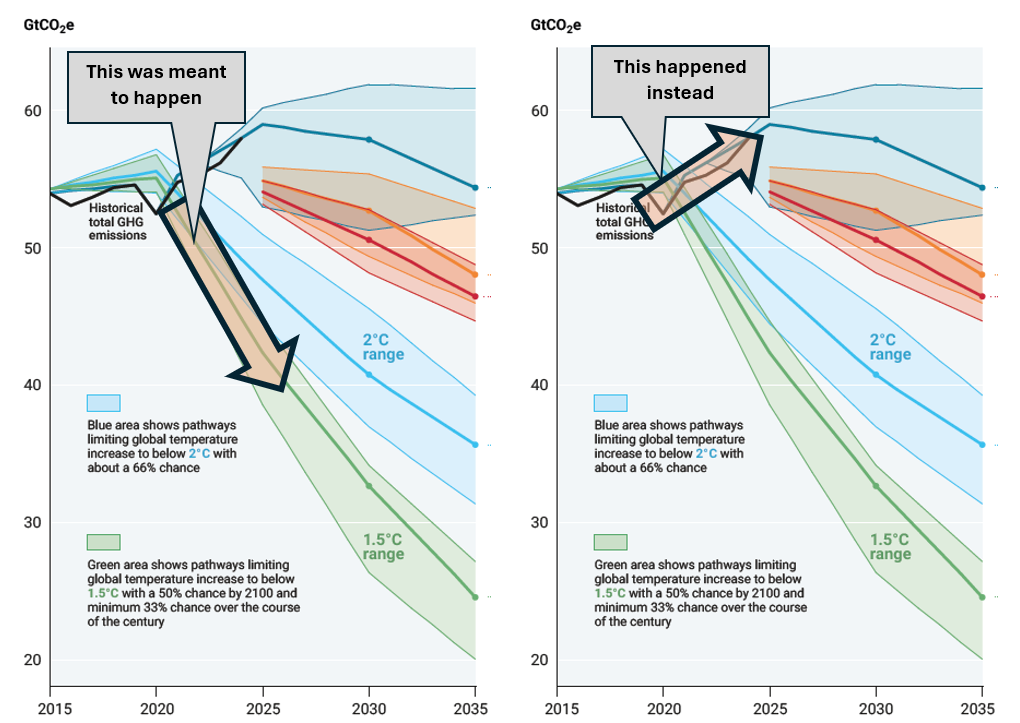
Now scientists are advising that the remaining GCB in 2025 is already much smaller than projected meaning that the pathway for 1.5°C needs to be revised with much steeper emission cuts (see charts below).
However, the UK Government is about to set a carbon budget validated against the earlier GCB claiming it “represents a credible contribution towards limiting warming to 1.5ºC”.
It is setting a carbon budget for a world that no longer exists.
The chart below. based on Figure 4.1 from the UNEP "Emissions Gap Report 2025", shows that any pathway to 1.5°C starts in a very different place in 2025 from the original green pathway projection.
LEGAL: THE UK CARBON BUDGET DOES NOT REFLECT “HIGHEST POSSIBLE AMBITION” AS REQUIRED BY RECENT AUTHORITATIVE INTERNATIONAL LEGAL OPINION
In 2025, the International Court of Justice (ICJ) delivered a unanimous Advisory Opinion (AO) confirming that States have authoritative obligations of “highest possible ambition” to align their mitigation measures (i.e. climate policies) with the 1.5°C limit.
The ICJ also confirmed that to meet international obligations under the Paris Agreement, countries like the UK require faster emissions cuts than developing countries—consistent with its equity principles of fairness between countries and across generations.
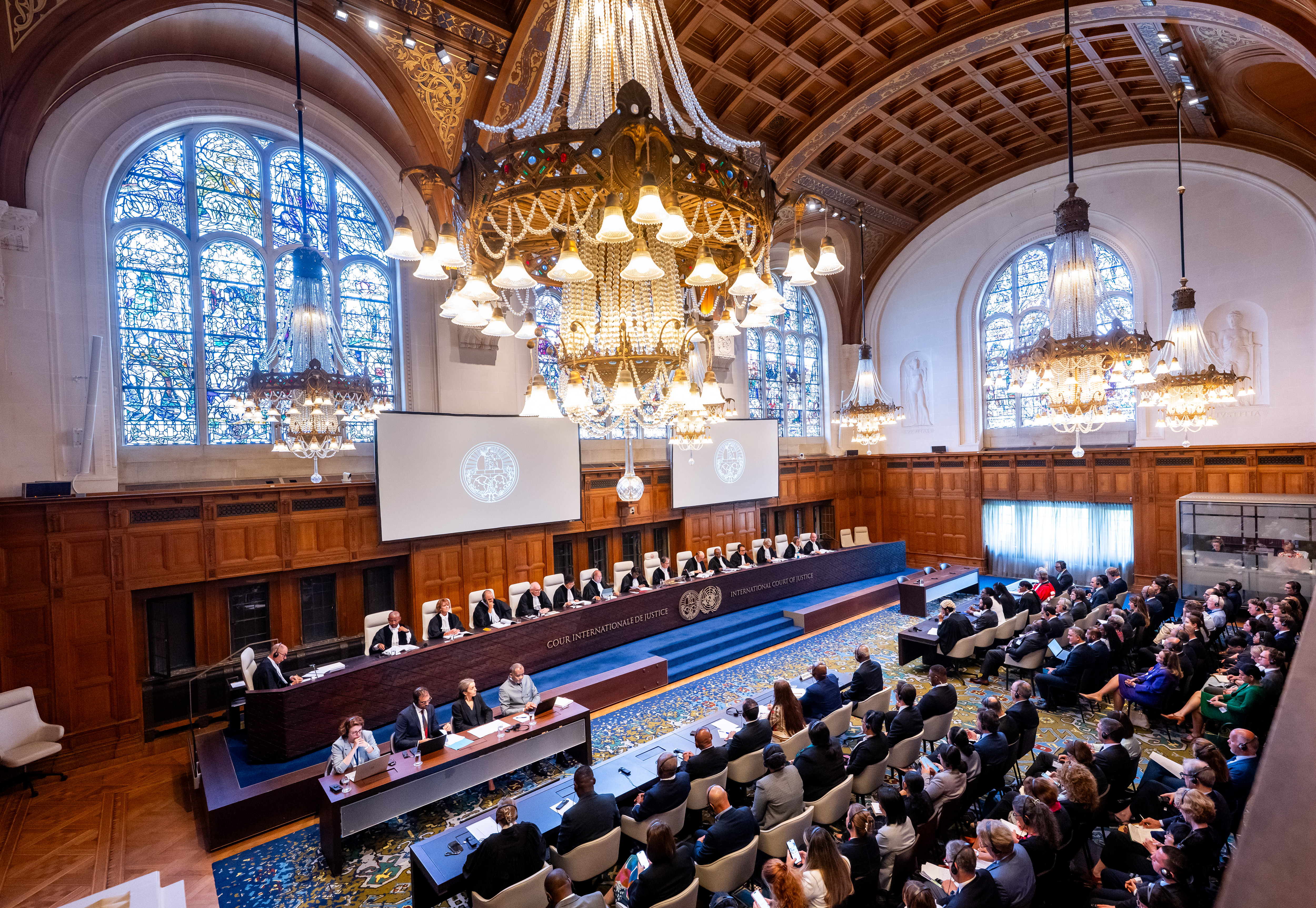
The photo below is the ICJ delivering its Advisory Opinion on 23 July 2025 (© International Court of Justice 2017–2026; All rights reserved)
Yet the new UK carbon budget cannot be the “highest possible ambition” as it has not been corrected for the latest science nor shown to meet the Paris equity principles.
WHAT IS THE BALANCED PATHWAY?
The UK Government sets carbon budgets twelve years in advance. By the end of June 2026, it will fix the limit for 2038–2042—the Seventh Carbon Budget (7CB). This is a legally binding five-year cap on UK greenhouse gas emissions across all sectors, including industry, transport and homes.
The Government is advised by the Climate Change Committee (CCC), which published its advice on the Seventh Carbon Budget (7CB) in February 2025. It recommends the so called “Balanced Pathway”—the CCC’s modelled route to net zero by 2050. The 7CB is one five-year segment of this pathway, built up from sector-level policies across the UK economy.
If the Balanced Pathway is not consistent with the latest science or international obligations, then the Seventh Carbon Budget cannot be either. To reflect the science, both the BP and the 7CB derived from it must be based on the current, smaller GCB now calculated by scientists.
MPs: UK’S CLIMATE CREDIBILITY STANDS OR FALLS ON THIS
Last year, Tyndall Centre scientists questioned if the UK carbon budget was genuinely consistent with the latest science in evidence submitted to the Environmental Audit Committee (EAC) of MPs in the UK Parliament.
“Given the rapidly shrinking global carbon budget and the strengthened scientific evidence since the Act’s establishment, the key question now is whether the CB7’s Net zero 2050 target and its ‘Balanced Pathway’ are genuinely consistent with the UK’s international obligations under the UNFCCC* to prevent irreversible damage to the climate system.” — Professor Kevin Anderson et al., evidence to the Environmental Audit Committee, 2025
*UNFCCC=United Nations Framework Convention on Climate Change. This is the overarching UK framework which includes the Paris Agreement.
And Carbon Reckoning asked the EAC MPs to:
“… press the Government and CCC to revise the 7CB using up-to-date global budgets, properly quantified UK allocations, quantified overshoot limits, transparent equity metrics, and without arbitrary fiscal constraints” — Dr Andrew Boswell of Carbon Reckoning, evidence to the Environmental Audit Committee, 2025
In its February 2026 report on the 7CB, the EAC acknowledged the issue.
“The credibility of the UK’s climate framework depends on domestic emissions limits being consistent with its obligations under the Paris Agreement and its commitment to a just transition, as well as the coherence of its overall contribution to global climate action." — Environmental Audit Committee, report on the Seventh Carbon Budget, 2026
The EAC then recommended that the Government set out clearly how the Seventh Carbon Budget aligns with the UK’s legally binding Paris obligations — including its “heightened obligations” as an Annex I Party under the UNFCCC.
“RECOMMENDATION: The Government should set out clearly in the impact assessment that will accompany the draft Carbon Budget Order, how the proposed legislative level of the Seventh Carbon Budget aligns with the United Kingdom’s legally binding obligations under the Paris Agreement, including how CB7 enables the UK to meet its status as an Annex I Party, with heightened responsibilities under the UNFCCC.” — Environmental Audit Committee, report on the Seventh Carbon Budget, 2026
THE PROPOSED LEGAL ARGUMENT
Under the Climate Change Act 2008, carbon budgets must be set with a view to significant developments in scientific knowledge or international law.
Carbon Reckoning contends the Balanced Pathway, and the 7CB level advised by the CCC, does not discharge the obligations imposed by the Climate Change Act to remain consistent with current international obligations and the best available science, nor does it align with the obligation on states to have the “highest possible ambition” to align their mitigation with the 1.5°C limit in the July 2025 Advisory Opinion of the International Court of Justice.
WHO ARE CARBON RECKONING? HOW WILL YOUR DONATION BE USED?
We are Andrew Boswell, James Hewitt, Rebecca Durant and Simon Pirani. Dr Andrew Boswell specialises in where science meets the law and has provided the evidence-based analysis to form the basis of Carbon Reckoning legal argument. James Hewitt specialises in policy and legality related to the use of products from forestland and on carbon in the electricity sector (including biomass and Carbon Capture and Storage). Rebecca Durant has a background in both the health service and the law, and is particularly interested in the scientific evidence used to justify government schemes in relation to the climate. Simon Pirani (honorary professor at the University of Durham) is a researcher and writer with expertise on fossil fuel consumption and energy systems. We are now working with lawyers and building a legal team.
At the moment, we are crowdfunding for the substantive stage of forensic legal work to build the legal arguments. Your donation today will fund the legal team, expert in the relevant climate laws, to develop the case. We need £10,000 for this work. (Any lower initial target is just set so it can be quickly reached to enable the crowdfunder to persist beyond one month).
We need this funding urgently so that our lawyers can formally write to the Government as soon as possible setting out the legal failures in the proposed carbon budget, and calling on it to address them.
Depending on how the Government responds, the next stage may involve commissioning expert witness statements from leading climate scientists, and further documenting forensically where the science used in the Balanced Pathway falls short of what the law requires. Future crowdfunding will fund the related legal work at this stage and may result in Carbon Reckoning taking the Government to court.
We are very grateful if you can support this vital legal action.
Carbon Reckoning are working pro-bono to forensically establish the legal shortcomings of the Government’s climate pathway and carbon budget setting. We are committed to the strongest possible action to require the UK sets climate policy commensurate with the scale of the crisis we face.
AND THAT MOMENT IS NOW
Carbon Reckoning is part of a growing movement demanding legal and parliamentary review of the UK climate plans against the latest science.
This proposed Carbon Reckoning legal action brings the latest authority on international law and climate science to bear on the inadequacy of the overall level set for the UK Seventh Carbon Budget due June 2026.
This is different but complementary to some other cases. Two landmark cases from Friends of the Earth, ClientEarth and Good Law Project found that the policy actions to deliver the previous Sixth Carbon Budget itself and their risk assessments were legally inadequate. And the Tipping Point/Good Law Project case, filed in September 2025, is the first ever challenge to the adequacy of the UK’s entire climate framework on human rights grounds.
Zero Hour’s Climate and Nature Bill campaign has 192 MPs pledged and nearly 400 local councils in support — building the parliamentary case alongside the legal one for improved climate laws and plans.
And public understanding is rapidly shifting beyond Parliament and the courts. The National Emergency Briefing film (the People's Emergency Briefing) — and the response it has generated — are evidence of a growing appetite for honest, urgent climate action. If you are reading this, you probably are already demanding that the Government takes the action that this crisis requires. A first step to do this is that the UK’s carbon budgets must be consistent with our international obligations and the latest science.
This vital legal action proposes to ensure that happens.
Carbon Reckoning thank you for any donation which you can generously make - so our lawyers can forensically establish the legal shortcomings of the Government’s climate pathway and carbon budget setting, and require the Government to take stronger action.

Carbon Reckoning
May 28, 2026
#CarbonReckoning: We have written to the Govt - just a month ot get carbon right
Thank you to everyone who has generously supported the #CarbonReckoning campaign.
We want to give you an important update — and the news is encouraging.
Over 115 people have now pledged, and we have raised over 60% of our initial target. The support from a wide community of people has got us this far. Thank you. If you haven't yet donated, please consider doing so now — every contribution helps us keep the pressure on.
The big news: last week we wrote to Ed Miliband warning that he has just a month to get the carbon budget right. Our letter sets out why the proposed budget is not aligned with the latest climate science and the UK's international commitments. It was fully reviewed and endorsed by our legal team.
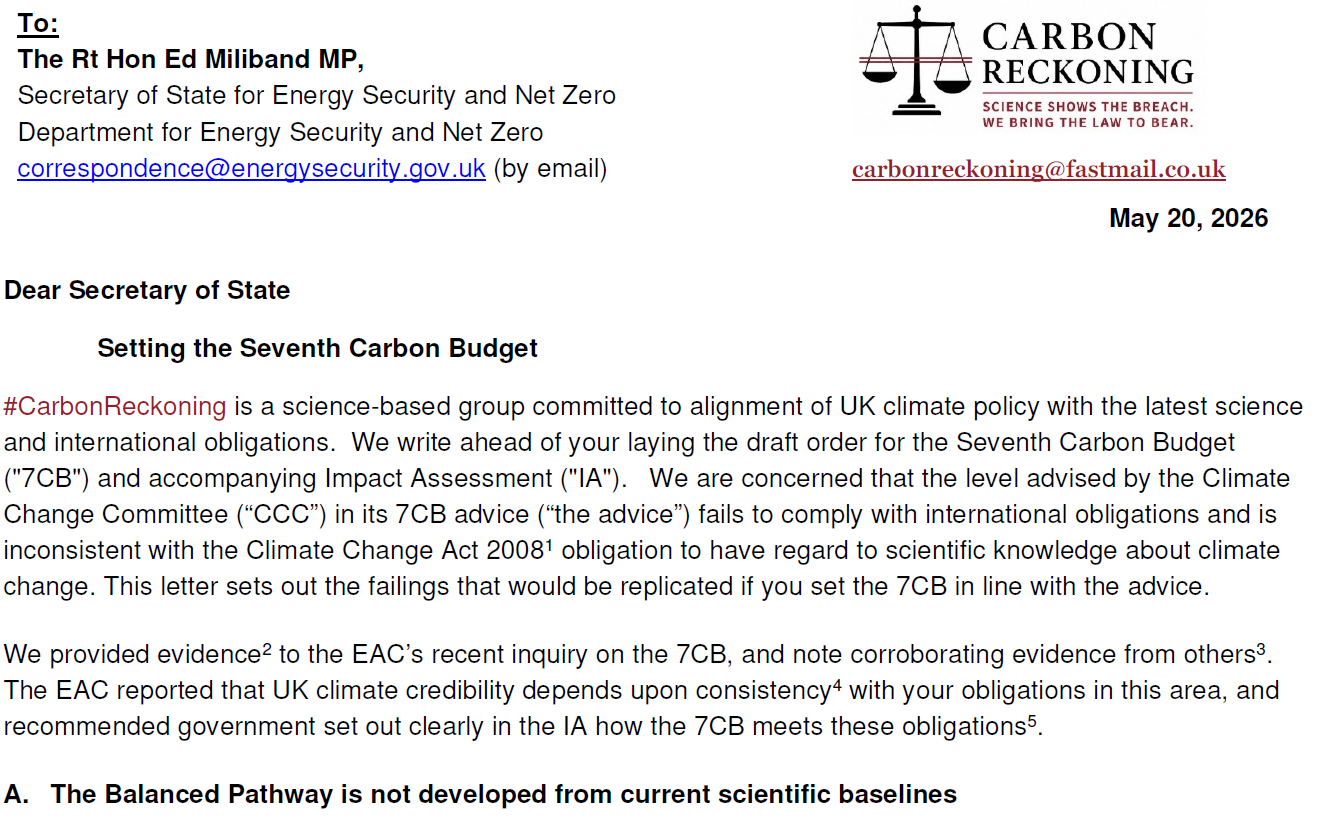
Once we have seen Mr Miliband's response — and the Government's Impact Assessment, which The Times reported last week is due very soon — we expect to send a formal legal letter. We are building the case step by step, and every donation makes that possible.
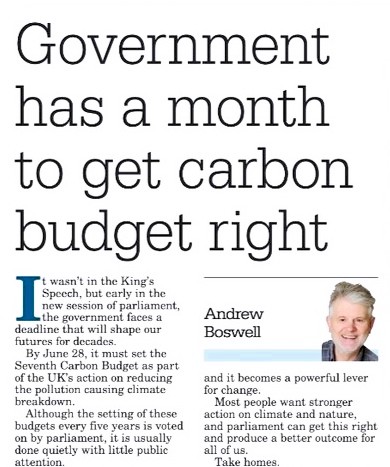
While we wait for the Government's response, we have also been making the case publicly. The #CarbonReckoning campaign was featured in the Eastern Daily Press with an opinion piece by campaign founder Andrew Boswell. The article explains how the Seventh Carbon Budget is already out of date before it is even set, and why all countries — including the UK — need significantly stronger ambition.
And if this UK budget were set in line with the science, it could become a powerful lever for change in our country:
- Driving mass investment in insulation, heat pumps, and rooftop solar — leading to warmer homes, lower bills, and an end to fuel poverty
- Creating thousands of skilled, well-paid jobs in every constituency
- Delivering real investment in public transport
- Protecting nature that is under growing pressure from a destabilising climate
- Providing resources for vital work in protecting our food security
We are asking the Government to walk the talk on climate action. With the climate breakdown already evident around us, getting this budget right matters — not just for the atmosphere, but for people's lives and livelihoods.
We're over halfway there on the first stage — please donate now if you can, and help our legal team develop the arguments for the next stage. Every pledge brings us closer to holding the Government to account.
Thank you for being part of this with us.
Andrew, James, Rebecca and Simon
Recent contributions